IMC 1994, Ημέρα 2, Θέμα 3
Let be a real-valued function with derivatives at each point of . Show that for each pair of real numbers , , , such that
there is a number in the open interval for which
Note that denotes the natural logarithm.
Πρωτότυπο από το επίσημο PDF
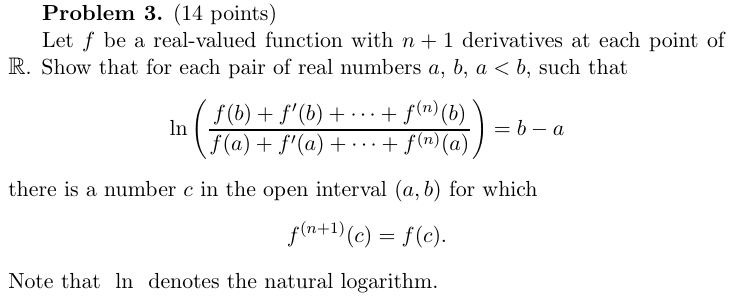
Η μεταγραφή συγκρίθηκε σύμβολο προς σύμβολο με το πρωτότυπο, όχι ακόμα από άνθρωπο.
Δούλεψε τουλάχιστον 45 λεπτά πριν ανοίξεις τη λύση.
Επίσημη λύση
Solution. Set . From the assumption one get . Then there exists such that . Replacing in the last equality we finish the proof.
Μεταγραφή από το επίσημο κείμενο λύσεων, σελίδα 7. Η μεταγραφή δεν έχει ελεγχθεί δεύτερη φορά· αν έχεις αμφιβολία, κοίτα το πρωτότυπο.
Θέμα αρχείου: η εκφώνηση είναι το επίσημο κείμενο (μεταγραμμένο, με το πρωτότυπο παραπάνω). Η ταξινόμηση ανά αντικείμενο και η δυσκολία εκτιμήθηκαν αυτόματα· υποδείξεις και λύση στα ελληνικά προστίθενται σταδιακά.
Πώς πήγε;
Οι κινήσεις που σημειώνεις επιστρέφουν νωρίτερα στη διαλογή.