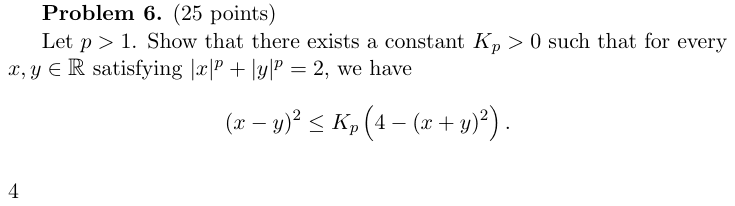
Let p>1. Show that there exists a constant Kp>0 such that for every x,y∈R satisfying ∣x∣p+∣y∣p=2, we have
(x−y)2≤Kp(4−(x+y)2).
Πρωτότυπο από το επίσημο PDF
Η μεταγραφή συγκρίθηκε σύμβολο προς σύμβολο με το πρωτότυπο, όχι ακόμα από άνθρωπο.
Χρόνος σε αυτό το θέμα
Δούλεψε τουλάχιστον 45 λεπτά πριν ανοίξεις τη λύση.
Επίσημη λύση
Solution. Let 0<δ<1. First we show that there exists Kp,δ>0 such that
f(x,y)=4−(x+y)2(x−y)2≤Kp,δ
for every (x,y)∈Dδ={(x,y):∣x−y∣≥δ,∣x∣p+∣y∣p=2}.
Since Dδ is compact it is enough to show that f is continuous on Dδ. For this we show that the denominator of f is different from zero. Assume the contrary. Then ∣x+y∣=2, and 2x+yp=1. Since p>1, the function g(t)=∣t∣p is strictly convex, in other words 2x+yp<2∣x∣p+∣y∣p whenever x=y. So for some (x,y)∈Dδ we have 2x+yp<2∣x∣p+∣y∣p=1=2x+yp. We get a contradiction.
If x and y have different signs then (x,y)∈Dδ for all 0<δ<1 because then ∣x−y∣≥max{∣x∣,∣y∣}≥1>δ. So we may further assume without loss of generality that x>0, y>0 and xp+yp=2. Set x=1+t. Then
if ∣x−1∣<δp. From the symmetry we have that (∗) also holds when ∣y−1∣<δp.
To finish the proof it is enough to show that ∣x−y∣≥2δp whenever ∣x−1∣≥δp, ∣y−1∣≥δp and xp+yp=2. Indeed, since xp+yp=2 we have that max{x,y}≥1. So let x−1≥δp. Since (2x+y)p≤2xp+yp=1 we get x+y≤2. Then x−y≥2(x−1)≥2δp.
Μεταγραφή από το επίσημο κείμενο λύσεων, σελίδες 5–6. Η μεταγραφή δεν έχει ελεγχθεί δεύτερη φορά· αν έχεις αμφιβολία, κοίτα το πρωτότυπο.
Θέμα αρχείου: η εκφώνηση είναι το επίσημο κείμενο (μεταγραμμένο, με το πρωτότυπο παραπάνω). Η ταξινόμηση ανά αντικείμενο και η δυσκολία εκτιμήθηκαν αυτόματα· υποδείξεις και λύση στα ελληνικά προστίθενται σταδιακά.
Πώς πήγε;
Οι κινήσεις που σημειώνεις επιστρέφουν νωρίτερα στη διαλογή.