uniolympiads English

IMC 1997, Ημέρα 2, Θέμα 4

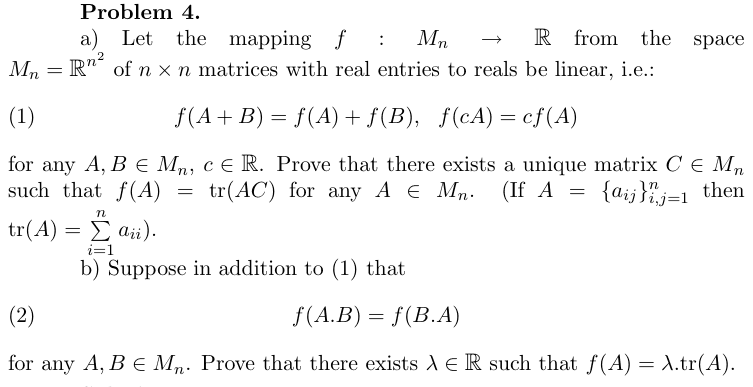
a) Let the mapping f ⁣:Mn→Rf\colon M_n \to \mathbb{R} from the space Mn=Rn2M_n = \mathbb{R}^{n^2} of n×nn \times n matrices with real entries to reals be linear, i.e.:

f(A+B)=f(A)+f(B),f(cA)=cf(A)(1)f(A + B) = f(A) + f(B), \quad f(cA) = cf(A) \qquad (1)

for any A,B∈MnA, B \in M_n, c∈Rc \in \mathbb{R}. Prove that there exists a unique matrix C∈MnC \in M_n such that f(A)=tr⁡(AC)f(A) = \operatorname{tr}(AC) for any A∈MnA \in M_n. (If A={aij}i,j=1nA = \{a_{ij}\}_{i,j=1}^{n} then tr⁡(A)=∑i=1naii\operatorname{tr}(A) = \sum_{i=1}^{n} a_{ii}.)

b) Suppose in addition to (1) that

f(A⋅B)=f(B⋅A)(2)f(A \cdot B) = f(B \cdot A) \qquad (2)

for any A,B∈MnA, B \in M_n. Prove that there exists λ∈R\lambda \in \mathbb{R} such that f(A)=λ⋅tr⁡(A)f(A) = \lambda \cdot \operatorname{tr}(A).

Πρωτότυπο από το επίσημο PDFa) Let the mapping f : M n → R from the n 2 M n = R of n × n matrices with real entries to reals be linear, i.e.: (1) space f (A + B) = f (A) + f (B), f (cA) = cf (A) for any A, B ∈ M n , c ∈ R . Prove that there exists a unique matrix C ∈ M n such that f (A) = tr(AC) for any A ∈ M n . (If A = {a ij } ni,j=1 then tr(A) = n P i=1 a ii ). b) Suppose in addition to (1) that (2) f (A.B) = f (B.A) for any A, B ∈ M n . Prove that there exists λ ∈ R such that f (A) = λ.tr(A).

Η μεταγραφή συγκρίθηκε σύμβολο προς σύμβολο με το πρωτότυπο, όχι ακόμα από άνθρωπο.

Χρόνος σε αυτό το θέμα 0:00

Δούλεψε τουλάχιστον 45 λεπτά πριν ανοίξεις τη λύση.

Επίσημη λύση

Solution. a) If we denote by EijE_{ij} the standard basis of MnM_n consisting of elementary matrix (with entry 1 at the place (i,j)(i,j) and zero elsewhere), then the entries cijc_{ij} of CC can be defined by cij=f(Eji)c_{ij} = f(E_{ji}). b) Denote by LL the n2−1n^2-1-dimensional linear subspace of MnM_n consisting of all matrices with zero trace. The elements EijE_{ij} with i≠ji \ne j and the elements Eii−EnnE_{ii} - E_{nn}, i=1,…,n−1i = 1, \ldots, n-1 form a linear basis for LL. Since

Eij=Eij.Ejj−Ejj.Eij, i≠jEii−Enn=Ein.Eni−Eni.Ein,i=1,…,n−1,\begin{aligned} E_{ij} &= E_{ij}.E_{jj} - E_{jj}.E_{ij}, \ i \ne j \\ E_{ii} - E_{nn} &= E_{in}.E_{ni} - E_{ni}.E_{in}, i = 1, \ldots, n-1, \end{aligned}
then the property (2) shows that ff is vanishing identically on LL. Now, for any A∈MnA \in M_n we have A−1ntr⁡(A).E∈LA - \dfrac1n \operatorname{tr}(A).E \in L, where EE is the identity matrix, and therefore f(A)=1nf(E).tr⁡(A)f(A) = \dfrac1n f(E).\operatorname{tr}(A).

Μεταγραφή από το επίσημο κείμενο λύσεων, σελίδες 3–4. Η μεταγραφή δεν έχει ελεγχθεί δεύτερη φορά· αν έχεις αμφιβολία, κοίτα το πρωτότυπο.

Θέμα αρχείου: η εκφώνηση είναι το επίσημο κείμενο (μεταγραμμένο, με το πρωτότυπο παραπάνω). Η ταξινόμηση ανά αντικείμενο και η δυσκολία εκτιμήθηκαν αυτόματα· υποδείξεις και λύση στα ελληνικά προστίθενται σταδιακά.

Πώς πήγε;