uniolympiads English

IMC 1997, Ημέρα 2, Θέμα 6

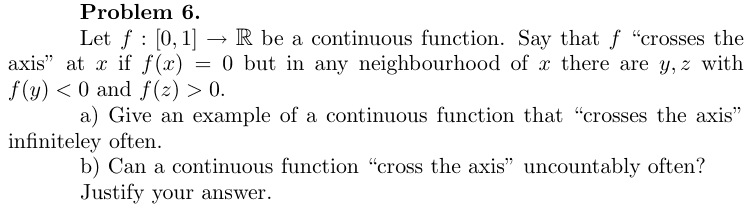
Let f ⁣:[0,1]→Rf\colon [0, 1] \to \mathbb{R} be a continuous function. Say that ff "crosses the axis" at xx if f(x)=0f(x) = 0 but in any neighbourhood of xx there are y,zy, z with f(y)<0f(y) < 0 and f(z)>0f(z) > 0.

a) Give an example of a continuous function that "crosses the axis" infiniteley often.

b) Can a continuous function "cross the axis" uncountably often? Justify your answer.

Πρωτότυπο από το επίσημο PDFLet f : [0, 1] → R be a continuous function. Say that f “crosses the axis” at x if f (x) = 0 but in any neighbourhood of x there are y, z with f (y) < 0 and f (z) > 0. a) Give an example of a continuous function that “crosses the axis” infiniteley often. b) Can a continuous function “cross the axis” uncountably often? Justify your answer.

Η μεταγραφή συγκρίθηκε σύμβολο προς σύμβολο με το πρωτότυπο, όχι ακόμα από άνθρωπο.

Χρόνος σε αυτό το θέμα 0:00

Δούλεψε τουλάχιστον 45 λεπτά πριν ανοίξεις τη λύση.

Επίσημη λύση

Solution. a) f(x)=xsin⁡1xf(x) = x \sin \dfrac1x.

b) Yes. The Cantor set is given by

C={x∈[0,1):x=∑j=1∞bj3−j, bj∈{0,2}}.C = \{x \in [0,1) : x = \sum_{j=1}^\infty b_j 3^{-j}, \ b_j \in \{0, 2\}\}.
There is an one-to-one mapping f:[0,1)→Cf : [0,1) \to C. Indeed, for x=∑j=1∞aj2−jx = \sum\limits_{j=1}^\infty a_j 2^{-j}, aj∈{0,1}a_j \in \{0,1\} we set f(x)=∑j=1∞(2aj)3−jf(x) = \sum\limits_{j=1}^\infty (2a_j) 3^{-j}. Hence CC is uncountable.

For k=1,2,…k = 1, 2, \ldots and i=0,1,2,…,2k−1−1i = 0, 1, 2, \ldots, 2^{k-1} - 1 we set

ak,i=3−k(6∑j=0k−2aj3j+1),bk,i=3−k(6∑j=0k−2aj3j+2),a_{k,i} = 3^{-k}\left(6\sum_{j=0}^{k-2} a_j 3^j + 1\right), \quad b_{k,i} = 3^{-k}\left(6\sum_{j=0}^{k-2} a_j 3^j + 2\right),
where i=∑j=0k−2aj2ji = \sum\limits_{j=0}^{k-2} a_j 2^j, aj∈{0,1}a_j \in \{0,1\}. Then
[0,1)∖C=⋃k=1∞⋃i=02k−1−1(ak,i,bk,i),[0,1) \setminus C = \bigcup_{k=1}^\infty \bigcup_{i=0}^{2^{k-1}-1} (a_{k,i}, b_{k,i}),
i.e. the Cantor set consists of all points which have a trinary representation with 0 and 2 as digits and the points of its compliment have some 1's in their trinary representation. Thus, ⋃i=02k−1−1(ak,i,bk,i)\bigcup\limits_{i=0}^{2^{k-1}-1} (a_{k,i}, b_{k,i}) are all points (exept ak,ia_{k,i}) which have 1 on kk-th place and 0 or 2 on the jj-th (j<kj < k) places.

Noticing that the points with at least one digit equals to 1 are everywhere dence in [0,1] we set

f(x)=∑k=1∞(−1)kgk(x).f(x) = \sum_{k=1}^\infty (-1)^k g_k(x).
where gkg_k is a piece-wise linear continuous functions with values at the knots
gk(ak,i+bk,i2)=2−k, gk(0)=gk(1)=gk(ak,i)=gk(bk,i)=0,g_k\left(\frac{a_{k,i} + b_{k,i}}{2}\right) = 2^{-k}, \ g_k(0) = g_k(1) = g_k(a_{k,i}) = g_k(b_{k,i}) = 0,
i=0,1,…,2k−1−1i = 0, 1, \ldots, 2^{k-1} - 1.

Then ff is continuous and ff "crosses the axis" at every point of the Cantor set.

Μεταγραφή από το επίσημο κείμενο λύσεων, σελίδες 4–5. Η μεταγραφή δεν έχει ελεγχθεί δεύτερη φορά· αν έχεις αμφιβολία, κοίτα το πρωτότυπο.
Θέμα αρχείου: η εκφώνηση είναι το επίσημο κείμενο (μεταγραμμένο, με το πρωτότυπο παραπάνω). Η ταξινόμηση ανά αντικείμενο και η δυσκολία εκτιμήθηκαν αυτόματα· υποδείξεις και λύση στα ελληνικά προστίθενται σταδιακά.

Πώς πήγε;