IMC 2002, Ημέρα 1, Θέμα 5
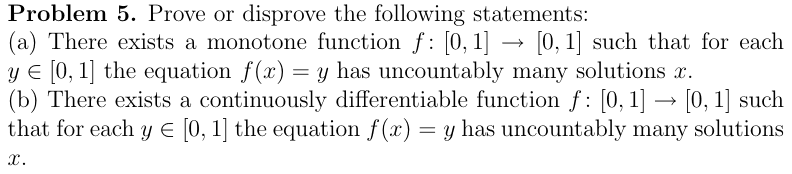
Prove or disprove the following statements:
(a) There exists a monotone function such that for each the equation has uncountably many solutions .
(b) There exists a continuously differentiable function such that for each the equation has uncountably many solutions .
Πρωτότυπο από το επίσημο PDF
Η μεταγραφή συγκρίθηκε σύμβολο προς σύμβολο με το πρωτότυπο, όχι ακόμα από άνθρωπο.
Δούλεψε τουλάχιστον 45 λεπτά πριν ανοίξεις τη λύση.
Επίσημη λύση
Solution. a. It does not exist. For each the set is either empty or consists of 1 point or is an interval. These sets are pairwise disjoint, so there are at most countably many of the third type.
b. Let be such a map. Then for each value of this map there is an such that and , because an uncountable set contains an accumulation point and clearly . For every and every such that there exists an open interval such that if then . The union of all these intervals may be written as a union of pairwise disjoint open intervals . The image of each is an interval (or a point) of length due to Lagrange Mean Value Theorem. Thus the image of the interval may be covered with the intervals such that the sum of their lengths is . This is not possible for .
Remarks. 1. The proof of part b is essentially the proof of the easy part of A. Sard's theorem about measure of the set of critical values of a smooth map.
- If only continuity is required, there exists such a function, e.g. the first co-ordinate of the very well known Peano curve which is a continuous map from an interval onto a square.
Μεταγραφή από το επίσημο κείμενο λύσεων, σελίδες 3–4. Η μεταγραφή δεν έχει ελεγχθεί δεύτερη φορά· αν έχεις αμφιβολία, κοίτα το πρωτότυπο.
Θέμα αρχείου: η εκφώνηση είναι το επίσημο κείμενο (μεταγραμμένο, με το πρωτότυπο παραπάνω). Η ταξινόμηση ανά αντικείμενο και η δυσκολία εκτιμήθηκαν αυτόματα· υποδείξεις και λύση στα ελληνικά προστίθενται σταδιακά.
Πώς πήγε;
Οι κινήσεις που σημειώνεις επιστρέφουν νωρίτερα στη διαλογή.