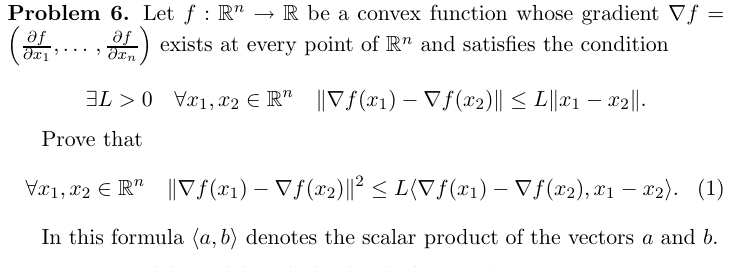
Solution. Let g(x)=f(x)−f(x1)−⟨∇f(x1),x−x1⟩. It is obvious that g has the same properties. Moreover, g(x1)=∇g(x1)=0 and, due to convexity, g has 0 as the absolute minimum at x1. Next we prove that
g(x2)≥2L1∥∇g(x2)∥2.(2)
Let
y0=x2−L1∥∇g(x2)∥ and
y(t)=y0+t(x2−y0). Then
g(x2)=g(y0)+∫01⟨∇g(y(t)),x2−y0⟩dt==g(y0)+⟨∇g(x2),x2−y0⟩−∫01⟨∇g(x2)−∇g(y(t)),x2−y0⟩dt≥≥0+L1∥∇g(x2)∥2−∫01∥∇g(x2)−∇g(y(t))∥⋅∥x2−y0∥dt≥≥L1∥∇g(x2)∥2−∥x2−y0∥∫01L∥x2−g(y)∥dt==L1∥∇g(x2)∥2−L∥x2−y0∥2∫01tdt=2L1∥∇g(x2)∥2.
Substituting the definition of g into (2), we obtain
f(x2)−f(x1)−⟨∇f(x1),x2−x1⟩≥2L1∥∇f(x2)−∇f(x1)∥2,
∥∇f(x2)−∇f(x1)∥2≤2L⟨∇f(x1),x1−x2⟩+2L(f(x2)−f(x1)).(3)
Exchanging variables
x1 and
x2, we have
∥∇f(x2)−∇f(x1)∥2≤2L⟨∇f(x2),x2−x1⟩+2L(f(x1)−f(x2)).(4)
The statement (1) is the average of (3) and (4).
Μεταγραφή από το επίσημο κείμενο λύσεων, σελίδα 4. Η μεταγραφή δεν έχει ελεγχθεί δεύτερη φορά· αν έχεις αμφιβολία, κοίτα το πρωτότυπο.