IMC 2003, Ημέρα 1, Θέμα 1
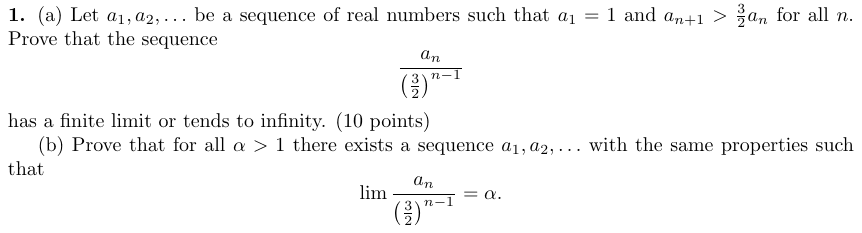
(a) Let be a sequence of real numbers such that and for all . Prove that the sequence
has a finite limit or tends to infinity. (10 points)
(b) Prove that for all there exists a sequence with the same properties such that
(10 points)
Πρωτότυπο από το επίσημο PDF
Η μεταγραφή συγκρίθηκε σύμβολο προς σύμβολο με το πρωτότυπο, όχι ακόμα από άνθρωπο.
Δούλεψε τουλάχιστον 45 λεπτά πριν ανοίξεις τη λύση.
Επίσημη λύση
Solution. (a) Let . Then is equivalent to , thus the sequence is strictly increasing. Each increasing sequence has a finite limit or tends to infinity.
(b) For all there exists a sequence which converges to . Choosing , we obtain the required sequence .
Μεταγραφή από το επίσημο κείμενο λύσεων, σελίδα 1. Η μεταγραφή δεν έχει ελεγχθεί δεύτερη φορά· αν έχεις αμφιβολία, κοίτα το πρωτότυπο.
Θέμα αρχείου: η εκφώνηση είναι το επίσημο κείμενο (μεταγραμμένο, με το πρωτότυπο παραπάνω). Η ταξινόμηση ανά αντικείμενο και η δυσκολία εκτιμήθηκαν αυτόματα· υποδείξεις και λύση στα ελληνικά προστίθενται σταδιακά.
Πώς πήγε;
Οι κινήσεις που σημειώνεις επιστρέφουν νωρίτερα στη διαλογή.