IMC 2003, Ημέρα 2, Θέμα 4
Find all positive integers for which there exists a family of three-element subsets of satisfying the following two conditions:
(i) for any two different elements , there exists exactly one containing both ;
(ii) if are elements of such that if , then .
Πρωτότυπο από το επίσημο PDF
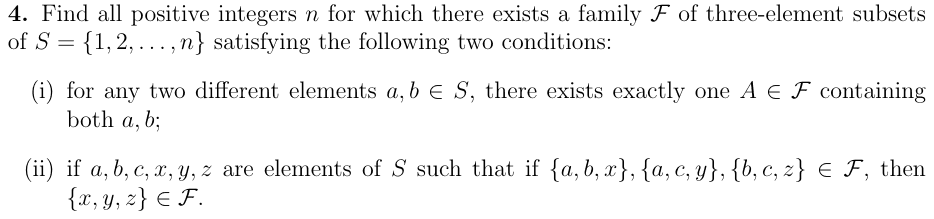
Η μεταγραφή συγκρίθηκε σύμβολο προς σύμβολο με το πρωτότυπο, όχι ακόμα από άνθρωπο.
Δούλεψε τουλάχιστον 45 λεπτά πριν ανοίξεις τη λύση.
Επίσημη λύση
Solution. The condition (i) of the problem allows us to define a (well-defined) operation on the set given by
(a) ;
(b) ;
(c) .
What does the condition (ii) give? It claims that
(e')
for any three different , i.e. that the operation is associative if the arguments are different. Now we can complete the definition of . In order to save associativity for non-different arguments, i.e. to make hold, we will add to an extra element, call it 0, and define
(d) and .
Now it is easy to check that, for any , (a),(b),(c) and (d), still hold, and
(e) .
We have thus obtained that has the structure of a finite Abelian group, whose elements are all of order two. Since the order of every such group is a power of 2, we conclude that and for some integer .
Given , according to what we have proven till now, we will construct a family of three-element subsets of satisfying (i) and (ii). Let us define the operation in the following manner:
if and , where are either 0 or 1, we put .
It is simple to check that this satisfies (a),(b),(c) and (e'). Therefore, if we include in all possible triples , the condition (i) follows from (a),(b) and (c), whereas the condition (ii) follows from (e')
The answer is: .
Μεταγραφή από το επίσημο κείμενο λύσεων, σελίδες 2–3. Η μεταγραφή δεν έχει ελεγχθεί δεύτερη φορά· αν έχεις αμφιβολία, κοίτα το πρωτότυπο.
Θέμα αρχείου: η εκφώνηση είναι το επίσημο κείμενο (μεταγραμμένο, με το πρωτότυπο παραπάνω). Η ταξινόμηση ανά αντικείμενο και η δυσκολία εκτιμήθηκαν αυτόματα· υποδείξεις και λύση στα ελληνικά προστίθενται σταδιακά.
Πώς πήγε;
Οι κινήσεις που σημειώνεις επιστρέφουν νωρίτερα στη διαλογή.