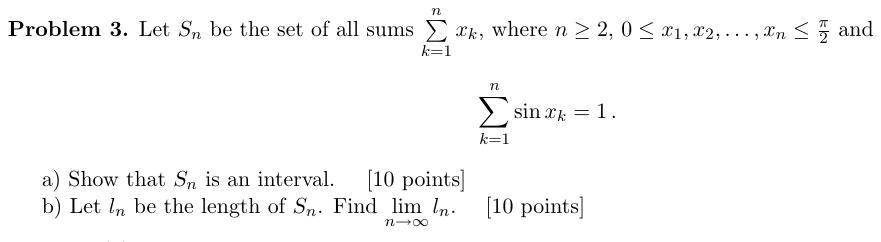
Solution. (a) Equivalently, we consider the set
Y={y=(y1,y2,...,yn)∣ 0≤y1,y2,...,yn≤1, y1+y2+...+yn=1}⊂Rn
and the image
f(Y) of
Y under
f(y)=arcsiny1+arcsiny2+...+arcsinyn.
Note that
f(Y)=Sn. Since
Y is a connected subspace of
Rn and
f is a continuous function, the image
f(Y) is also connected, and we know that the only connected subspaces of
R are intervals. Thus
Sn is an interval.
(b) We prove that
n arcsinn1≤x1+x2+...+xn≤2π.
Since the graph of
sinx is concave down for
x∈[0,2π], the chord joining the points
(0,0) and
(2π,1) lies below the graph. Hence
π2x≤sinx for all x∈[0,2π]
and we can deduce the right-hand side of the claim:
π2(x1+x2+...+xn)≤sinx1+sinx2+...+sinxn=1.
The value 1 can be reached choosing
x1=2π and
x2=⋯=xn=0.
The left-hand side follows immediately from Jensen's inequality, since sinx is concave down for x∈[0,2π] and 0≤nx1+x2+...+xn<2π
n1=nsinx1+sinx2+...+sinxn≤sinnx1+x2+...+xn.
Equality holds if
x1=⋯=xn=arcsinn1.
Now we have computed the minimum and maximum of interval Sn; we can conclude that Sn=[n arcsinn1,2π]. Thus ln=2π−n arcsinn1 and
n→∞limln=2π−n→∞lim1/narcsin(1/n)=2π−1.
Μεταγραφή από το επίσημο κείμενο λύσεων, σελίδες 1–2. Η μεταγραφή δεν έχει ελεγχθεί δεύτερη φορά· αν έχεις αμφιβολία, κοίτα το πρωτότυπο.