uniolympiads English

IMC 2006, Ημέρα 2, Θέμα 6

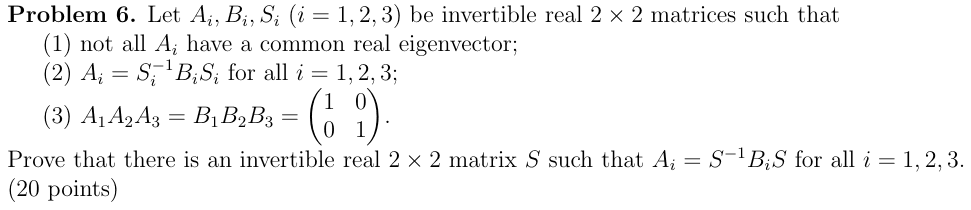
Let Ai,Bi,SiA_i, B_i, S_i (i=1,2,3)(i = 1, 2, 3) be invertible real 2×22 \times 2 matrices such that

(1) not all AiA_i have a common real eigenvector;

(2) Ai=Si−1BiSiA_i = S_i^{-1}B_iS_i for all i=1,2,3i = 1, 2, 3;

(3) A1A2A3=B1B2B3=(1001)A_1A_2A_3 = B_1B_2B_3 = \begin{pmatrix} 1 & 0 \\ 0 & 1 \end{pmatrix}.

Prove that there is an invertible real 2×22 \times 2 matrix SS such that Ai=S−1BiSA_i = S^{-1}B_iS for all i=1,2,3i = 1, 2, 3.

Πρωτότυπο από το επίσημο PDFLet A i , B i , S i (i = 1, 2, 3) be invertible real 2 × 2 matrices such that (1) not all A i have a common real eigenvector; (2) A i = S i −1 B i S i for all i = 1, 2, 3; 1 0 . (3) A 1 A 2 A 3 = B 1 B 2 B 3 = 0 1 Prove that there is an invertible real 2 × 2 matrix S such that A i = S −1 B i S for all i = 1, 2, 3. (20 points)

Η μεταγραφή συγκρίθηκε σύμβολο προς σύμβολο με το πρωτότυπο, όχι ακόμα από άνθρωπο.

Χρόνος σε αυτό το θέμα 0:00

Δούλεψε τουλάχιστον 45 λεπτά πριν ανοίξεις τη λύση.

Επίσημη λύση

Solution. We note that the problem is trivial if Aj=λIA_j=\lambda I for some jj, so suppose this is not the case. Consider then first the situation where some AjA_j, say A3A_3, has two distinct real eigenvalues. We may assume that A3=B3=(λμ)A_3=B_3=\left(\begin{smallmatrix}\lambda&\\&\mu\end{smallmatrix}\right) by conjugating both sides. Let A2=(abcd)A_2=\left(\begin{smallmatrix}a&b\\c&d\end{smallmatrix}\right) and B2=(a′b′c′d′)B_2=\left(\begin{smallmatrix}a'&b'\\c'&d'\end{smallmatrix}\right). Then

a+d=Tr⁡A2=Tr⁡B2=a′+d′aλ+dμ=Tr⁡(A2A3)=Tr⁡A1−1=Tr⁡B1−1=Tr⁡(B2B3)=a′λ+d′μ.\begin{aligned} a+d=\operatorname{Tr}A_2 &= \operatorname{Tr}B_2=a'+d'\\ a\lambda+d\mu=\operatorname{Tr}(A_2A_3)=\operatorname{Tr}A_1^{-1} &= \operatorname{Tr}B_1^{-1}=\operatorname{Tr}(B_2B_3)=a'\lambda+d'\mu. \end{aligned}
Hence a=a′a=a' and d=d′d=d' and so also bc=b′c′bc=b'c'. Now we cannot have c=0c=0 or b=0b=0, for then (1,0)⊤(1,0)^\top or (0,1)⊤(0,1)^\top would be a common eigenvector of all AjA_j. The matrix S=(c′c)S=\left(\begin{smallmatrix}c'&\\&c\end{smallmatrix}\right) conjugates A2=S−1B2SA_2=S^{-1}B_2S, and as SS commutes with A3=B3A_3=B_3, it follows that Aj=S−1BjSA_j=S^{-1}B_jS for all jj.

If the distinct eigenvalues of A3=B3A_3=B_3 are not real, we know from above that Aj=S−1BjSA_j=S^{-1}B_jS for some S∈GL2CS\in\mathrm{GL}_2\mathbb{C} unless all AjA_j have a common eigenvector over C\mathbb{C}. Even if they do, say Ajv=λjvA_jv=\lambda_jv, by taking the conjugate square root it follows that AjA_j's can be simultaneously diagonalized. If A2=(ad)A_2=\left(\begin{smallmatrix}a&\\&d\end{smallmatrix}\right) and B2=(a′b′c′d′)B_2=\left(\begin{smallmatrix}a'&b'\\c'&d'\end{smallmatrix}\right), it follows as above that a=a′a=a', d=d′d=d' and so b′c′=0b'c'=0. Now B2B_2 and B3B_3 (and hence B1B_1 too) have a common eigenvector over C\mathbb{C} so they too can be simultaneously diagonalized. And so SAj=BjSSA_j=B_jS for some S∈GL2CS\in\mathrm{GL}_2\mathbb{C} in either case. Let S0=Re⁡SS_0=\operatorname{Re}S and S1=Im⁡SS_1=\operatorname{Im}S. By separating the real and imaginary components, we are done if either S0S_0 or S1S_1 is invertible. If not, S0S_0 may be conjugated to some T−1S0T=(x0y0)T^{-1}S_0T=\left(\begin{smallmatrix}x&0\\y&0\end{smallmatrix}\right), with (x,y)⊤≠(0,0)⊤(x,y)^\top\ne(0,0)^\top, and it follows that all AjA_j have a common eigenvector T(0,1)⊤T(0,1)^\top, a contradiction.

We are left with the case when no AjA_j has distinct eigenvalues; then these eigenvalues by necessity are real. By conjugation and division by scalars we may assume that A3=(1b1)A_3=\left(\begin{smallmatrix}1&b\\&1\end{smallmatrix}\right) and b≠0b\ne0. By further conjugation by upper-triangular matrices (which preserves the shape of A3A_3 up to the value of bb) we can also assume that A2=(0u1v)A_2=\left(\begin{smallmatrix}0&u\\1&v\end{smallmatrix}\right). Here v2=Tr⁡2A2=4det⁡A2=−4uv^2=\operatorname{Tr}^2A_2=4\det A_2=-4u. Now A1=A3−1A2−1=(−(b+v)/u11/u)A_1=A_3^{-1}A_2^{-1}=\left(\begin{smallmatrix}-(b+v)/u&1\\1/u&\end{smallmatrix}\right), and hence (b+v)2/u2=Tr⁡2A1=4det⁡A1=−4/u(b+v)^2/u^2=\operatorname{Tr}^2A_1=4\det A_1=-4/u. Comparing these two it follows that b=−2vb=-2v. What we have done is simultaneously reduced all AjA_j to matrices whose all entries depend on uu and vv (=−det⁡A2=-\det A_2 and Tr⁡A2\operatorname{Tr}A_2, respectively) only, but these themselves are invariant under similarity. So BjB_j's can be simultaneously reduced to the very same matrices.

Μεταγραφή από το επίσημο κείμενο λύσεων, σελίδες 3–4. Η μεταγραφή δεν έχει ελεγχθεί δεύτερη φορά· αν έχεις αμφιβολία, κοίτα το πρωτότυπο.

Θέμα αρχείου: η εκφώνηση είναι το επίσημο κείμενο (μεταγραμμένο, με το πρωτότυπο παραπάνω). Η ταξινόμηση ανά αντικείμενο και η δυσκολία εκτιμήθηκαν αυτόματα· υποδείξεις και λύση στα ελληνικά προστίθενται σταδιακά.

Πώς πήγε;