uniolympiads English

IMC 2007, Ημέρα 2, Θέμα 4

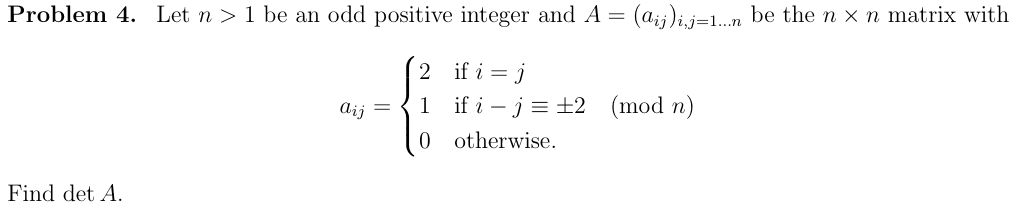
Let n>1n > 1 be an odd positive integer and A=(aij)i,j=1…nA = (a_{ij})_{i,j=1\dots n} be the n×nn \times n matrix with

aij={2if i=j1if i−j≡±2(modn)0otherwise.a_{ij} = \begin{cases} 2 & \text{if } i = j \\ 1 & \text{if } i - j \equiv \pm 2 \pmod n \\ 0 & \text{otherwise.} \end{cases}

Find det⁡A\det A.

Πρωτότυπο από το επίσημο PDFLet n > 1 be an odd positive integer and A = (a ij ) i,j=1...n be the n × n matrix with    2 if i = j a ij = 1 if i − j ≡ ±2 (mod n)   0 otherwise. Find det A. 1 1 if i − j ≡ ±1 (mod n)

Η μεταγραφή συγκρίθηκε σύμβολο προς σύμβολο με το πρωτότυπο, όχι ακόμα από άνθρωπο.

Χρόνος σε αυτό το θέμα 0:00

Δούλεψε τουλάχιστον 45 λεπτά πριν ανοίξεις τη λύση.

Επίσημη λύση

Solution. Notice that A=B2A=B^2, with bij={1if i−j≡±1(modn)0otherwiseb_{ij}=\begin{cases}1&\text{if }i-j\equiv\pm1\pmod n\\0&\text{otherwise}\end{cases}. So it is sufficient to find det⁡B\det B.

To find det⁡B\det B, expand the determinant with respect to the first row, and then expad both terms with respect to the first column.

det⁡B=∣0111011011⋱⋱⋱01101110∣=−∣11011⋱⋱⋱01101110∣+∣1011011⋱⋱⋱011011∣=−(∣011⋱⋱⋱0110110∣−∣1011⋱⋱⋱01101∣)+(∣1011⋱⋱⋱01101∣−∣011011⋱⋱⋱0110∣)=−(0−1)+(1−0)=2,\begin{aligned}\det B&=\begin{vmatrix}0&1&&&&&1\\1&0&1&&&&\\&1&0&1&&&\\&&1&\ddots&\ddots&&\\&&&\ddots&0&1&\\&&&&1&0&1\\1&&&&&1&0\end{vmatrix}=-\begin{vmatrix}1&1&&&&\\&0&1&&&\\&1&\ddots&\ddots&&\\&&\ddots&0&1&\\&&&1&0&1\\1&&&&1&0\end{vmatrix}+\begin{vmatrix}1&0&1&&&\\&1&0&1&&\\&&1&\ddots&\ddots&\\&&&\ddots&0&1\\&&&&1&0\\1&&&&&1\end{vmatrix}\\&=-\left(\begin{vmatrix}0&1&&&\\1&\ddots&\ddots&&\\&\ddots&0&1&\\&&1&0&1\\&&&1&0\end{vmatrix}-\begin{vmatrix}1&&&&\\0&1&&&\\1&\ddots&\ddots&&\\&\ddots&0&1&\\&&1&0&1\end{vmatrix}\right)+\left(\begin{vmatrix}1&0&1&&\\&1&\ddots&\ddots&\\&&\ddots&0&1\\&&&1&0\\&&&&1\end{vmatrix}-\begin{vmatrix}0&1&&&\\1&0&1&&\\&1&\ddots&\ddots&\\&&\ddots&0&1\\&&&1&0\end{vmatrix}\right)\\&=-(0-1)+(1-0)=2,\end{aligned}
since the second and the third matrices are lower/upper triangular, while in the first and the fourth matrices we have row1−row3+row5−⋯±rown−2=0ˉ\text{row}_1-\text{row}_3+\text{row}_5-\dots\pm\text{row}_{n-2}=\bar0.

So det⁡B=2\det B=2 and thus det⁡A=4\det A=4.

Μεταγραφή από το επίσημο κείμενο λύσεων, σελίδα 2. Η μεταγραφή δεν έχει ελεγχθεί δεύτερη φορά· αν έχεις αμφιβολία, κοίτα το πρωτότυπο.

Θέμα αρχείου: η εκφώνηση είναι το επίσημο κείμενο (μεταγραμμένο, με το πρωτότυπο παραπάνω). Η ταξινόμηση ανά αντικείμενο και η δυσκολία εκτιμήθηκαν αυτόματα· υποδείξεις και λύση στα ελληνικά προστίθενται σταδιακά.

Πώς πήγε;