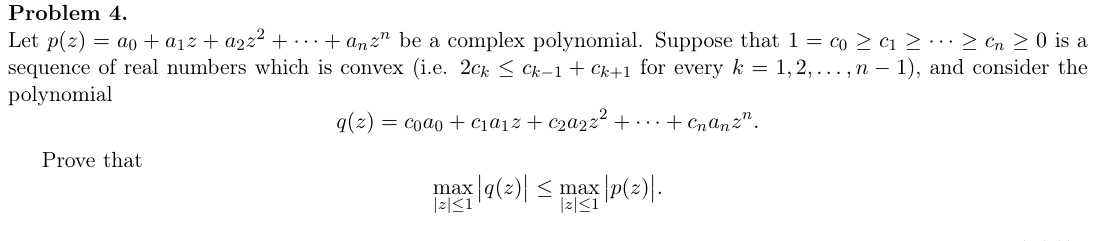
Let p(z)=a0+a1z+a2z2+⋯+anzn be a complex polynomial. Suppose that 1=c0≥c1≥⋯≥cn≥0 is a sequence of real numbers which is convex (i.e. 2ck≤ck−1+ck+1 for every k=1,2,…,n−1), and consider the polynomial
q(z)=c0a0+c1a1z+c2a2z2+⋯+cnanzn.
Prove that
∣z∣≤1max∣q(z)∣≤∣z∣≤1max∣p(z)∣.
Πρωτότυπο από το επίσημο PDF
Η μεταγραφή συγκρίθηκε σύμβολο προς σύμβολο με το πρωτότυπο, όχι ακόμα από άνθρωπο.
Χρόνος σε αυτό το θέμα
Δούλεψε τουλάχιστον 45 λεπτά πριν ανοίξεις τη λύση.
Επίσημη λύση
Solution. The polynomials p and q are regular on the complex plane, so by the Maximum Principle, max∣z∣≤1∣q(z)∣=max∣z∣=1∣q(z)∣, and similarly for p. Let us denote Mf=max∣z∣=1∣f(z)∣ for any regular function f. Thus it suffices to prove that Mq≤Mp.
First, note that we can assume cn=0. Indeed, for cn=1, we get p=q and the statement is trivial; otherwise, q(z)=cnp(z)+(1−cn)r(z), where r(z)=∑j=0n1−cncj−cnajzj. The sequence cj′=1−cncj−cn also satisfies the prescribed conditions (it is a positive linear transform of the sequence cn with c0′=1), but cn′=0 too, so we get Mr≤Mp. This is enough: Mq=∣q(z0)∣≤cn∣p(z0)∣+(1−cn)∣r(z0)∣≤cnMp+(1−cn)Mr≤Mp.
Using the Cauchy formulas, we can express the coefficients aj of p from its values taken over the positively oriented circle S={∣z∣=1}:
aj=2πi1∫Szj+1p(z)dz=2π1∫Szjp(z)∣dz∣
for 0≤j≤n, otherwise
∫Szjp(z)∣dz∣=0.
Let us use these identities to get a new formula for q, using only the values of p over S:
2π⋅q(w)=j=0∑ncj(∫Sp(z)z−j∣dz∣)wj.
We can exchange the order of the summation and the integration (sufficient conditions to do this obviously apply):
2π⋅q(w)=∫S(j=0∑ncj(w/z)j)p(z)∣dz∣.
It would be nice if the integration kernel (the sum between the brackets) was real. But this is easily arranged – for −n≤j≤−1, we can add the conjugate expressions, because by the above remarks, they are zero anyway:
Let us examine K(u). It is a real-valued function. Again from the Cauchy formulas, ∫SK(u)∣du∣=2πc0=2π. If ∫S∣K(u)∣∣du∣=2π still holds (taking the absolute value does not increase the integral), then for every w:
this would conclude the proof. So it suffices to prove that ∫S∣K(u)∣∣du∣=∫SK(u)∣du∣, which is to say, K is non-negative.
[Figure in the original PDF.]
Now let us decompose K into a sum using the given conditions for the numbers cj (including cn=0). Let dk=ck−1−2ck+ck+1 for k=1,…,n (setting cn+1=0); we know that dk≥0. Let Fk(u)=∑j=−k+1k−1(k−∣j∣)uj. Then K(u)=∑k=1ndkFk(u) by easy induction (or see Figure for a graphical illustration). So it suffices to prove that Fk(u) is real and Fk(u)≥0 for u∈S. This is reasonably well-known (as kFk is the Fejér kernel), and also very easy:
Μεταγραφή από το επίσημο κείμενο λύσεων, σελίδες 2–3. Η μεταγραφή δεν έχει ελεγχθεί δεύτερη φορά· αν έχεις αμφιβολία, κοίτα το πρωτότυπο.
Θέμα αρχείου: η εκφώνηση είναι το επίσημο κείμενο (μεταγραμμένο, με το πρωτότυπο παραπάνω). Η ταξινόμηση ανά αντικείμενο και η δυσκολία εκτιμήθηκαν αυτόματα· υποδείξεις και λύση στα ελληνικά προστίθενται σταδιακά.
Πώς πήγε;
Οι κινήσεις που σημειώνεις επιστρέφουν νωρίτερα στη διαλογή.