uniolympiads English

IMC 2009, Ημέρα 2, Θέμα 3

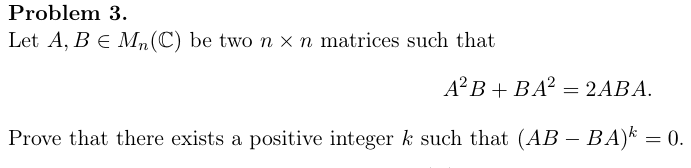
Let A,B∈Mn(C)A, B \in M_n(\mathbb{C}) be two n×nn \times n matrices such that

A2B+BA2=2ABA.A^2B + BA^2 = 2ABA.

Prove that there exists a positive integer kk such that (AB−BA)k=0(AB - BA)^k = 0.

Πρωτότυπο από το επίσημο PDFLet A, B ∈ M n (C) be two n × n matrices such that A 2 B + BA 2 = 2ABA. Prove that there exists a positive integer k such that (AB − BA) k = 0.

Η μεταγραφή συγκρίθηκε σύμβολο προς σύμβολο με το πρωτότυπο, όχι ακόμα από άνθρωπο.

Χρόνος σε αυτό το θέμα 0:00

Δούλεψε τουλάχιστον 45 λεπτά πριν ανοίξεις τη λύση.

Επίσημη λύση

Solution 1. Let us fix the matrix A∈Mn(C)A \in M_n(\mathbb{C}). For every matrix X∈Mn(C)X \in M_n(\mathbb{C}), let ΔX:=AX−XA\Delta X := AX - XA. We need to prove that the matrix ΔB\Delta B is nilpotent.

Observe that the condition A2B+BA2=2ABAA^2B + BA^2 = 2ABA is equivalent to

Δ2B=Δ(ΔB)=0.(1)\Delta^2B = \Delta(\Delta B) = 0. \tag{1}
Δ\Delta is linear; moreover, it is a derivation, i.e. it satisfies the Leibniz rule:
Δ(XY)=(ΔX)Y+X(ΔY),∀X,Y∈Mn(C).\Delta(XY) = (\Delta X)Y + X(\Delta Y),\quad \forall X, Y \in M_n(\mathbb{C}).
Using induction, one can easily generalize the above formula to kk factors:
Δ(X1⋯Xk)=(ΔX1)X2⋯Xk+⋯+X1⋯Xj−1(ΔXj)Xj+1⋯Xk+X1⋯Xn−1ΔXk,(2)\Delta(X_1\cdots X_k) = (\Delta X_1)X_2\cdots X_k + \cdots + X_1\cdots X_{j-1}(\Delta X_j)X_{j+1}\cdots X_k + X_1\cdots X_{n-1}\Delta X_k, \tag{2}
for any matrices X1,X2,…,Xk∈Mn(C)X_1, X_2, \ldots, X_k \in M_n(\mathbb{C}). Using the identities (1) and (2) we obtain the equation for Δk(Bk)\Delta^k(B^k):
Δk(Bk)=k!(ΔB)k,∀k∈N.(3)\Delta^k(B^k) = k!(\Delta B)^k,\quad \forall k \in \mathbb{N}. \tag{3}
By the last equation it is enough to show that Δn(Bn)=0\Delta^n(B^n) = 0.

To prove this, first we observe that equation (3) together with the fact that Δ2B=0\Delta^2B = 0 implies that Δk+1Bk=0\Delta^{k+1}B^k = 0, for every k∈Nk \in \mathbb{N}. Hence, we have

Δk(Bj)=0,∀k,j∈N, j<k.(4)\Delta^k(B^j) = 0,\quad \forall k, j \in \mathbb{N},\ j < k. \tag{4}
By the Cayley–Hamilton Theorem, there are scalars α0,α1,…,αn−1∈C\alpha_0, \alpha_1, \ldots, \alpha_{n-1} \in \mathbb{C} such that
Bn=α0I+α1B+⋯+αn−1Bn−1,B^n = \alpha_0I + \alpha_1B + \cdots + \alpha_{n-1}B^{n-1},
which together with (4) implies that ΔnBn=0\Delta^nB^n = 0.

Solution 2. Set X=AB−BAX = AB - BA. The matrix XX commutes with AA because

AX−XA=(A2B−ABA)−(ABA−BA2)=A2B+BA2−2ABA=0.AX - XA = (A^2B - ABA) - (ABA - BA^2) = A^2B + BA^2 - 2ABA = 0.
Hence for any m≥0m \ge 0 we have
Xm+1=Xm(AB−BA)=AXmB−XmBA.X^{m+1} = X^m(AB - BA) = AX^mB - X^mBA.
Take the trace of both sides:
tr⁡Xm+1=tr⁡A(XmB)−tr⁡(XmB)A=0\operatorname{tr}X^{m+1} = \operatorname{tr}A(X^mB) - \operatorname{tr}(X^mB)A = 0
(since for any matrices UU and VV, we have tr⁡UV=tr⁡VU\operatorname{tr}UV = \operatorname{tr}VU). As tr⁡Xm+1\operatorname{tr}X^{m+1} is the sum of the m+1m+1-st powers of the eigenvalues of XX, the values of tr⁡X,…,tr⁡Xn\operatorname{tr}X, \ldots, \operatorname{tr}X^n determine the eigenvalues of XX uniquely, therefore all of these eigenvalues have to be 0. This implies that XX is nilpotent.

Μεταγραφή από το επίσημο κείμενο λύσεων, σελίδα 2. Η μεταγραφή δεν έχει ελεγχθεί δεύτερη φορά· αν έχεις αμφιβολία, κοίτα το πρωτότυπο.
Θέμα αρχείου: η εκφώνηση είναι το επίσημο κείμενο (μεταγραμμένο, με το πρωτότυπο παραπάνω). Η ταξινόμηση ανά αντικείμενο και η δυσκολία εκτιμήθηκαν αυτόματα· υποδείξεις και λύση στα ελληνικά προστίθενται σταδιακά.

Πώς πήγε;