IMC 2011, Ημέρα 2, Θέμα 5
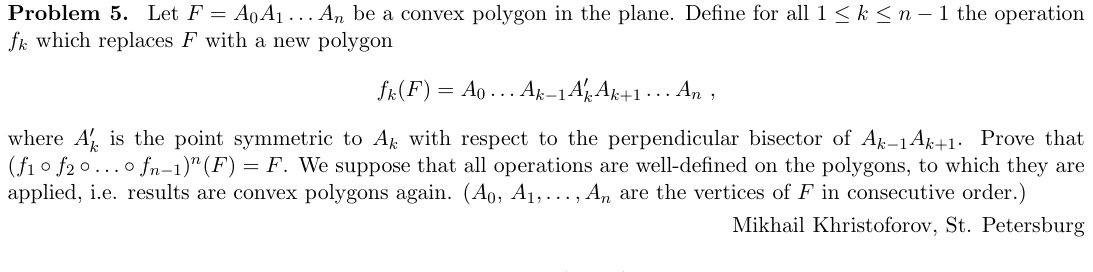
Let be a convex polygon in the plane. Define for all the operation which replaces with a new polygon
where is the point symmetric to with respect to the perpendicular bisector of . Prove that . We suppose that all operations are well-defined on the polygons, to which they are applied, i.e. results are convex polygons again. ( are the vertices of in consecutive order.)
Mikhail Khristoforov, St. Petersburg
Πρωτότυπο από το επίσημο PDF
Η μεταγραφή συγκρίθηκε σύμβολο προς σύμβολο με το πρωτότυπο, όχι ακόμα από άνθρωπο.
Δούλεψε τουλάχιστον 45 λεπτά πριν ανοίξεις τη λύση.
Επίσημη λύση
Mikhail Khristoforov, St. Petersburg
Solution. The operations are rational maps on the -dimensional phase space of coordinates of the vertices . To show that is the identity, it is sufficient to verify this on some open set. For example, we can choose a neighborhood of the regular polygon, then all intermediate polygons in the proof will be convex.
Consider the operations . Notice that (i) and (ii) for . We also show that (iii) for .
The operations and change the order of side lengths by interchanging two consecutive sides; after performing , the side lengths are in the original order. Moreover, the sums of opposite angles in the convex quadrilateral are preserved in all operations. These quantities uniquely determine the quadrilateral, because with fixed sides, both angles and decrease when increases. Hence, property (iii) is proved.
In the symmetric group , the transpositions , which from a generator system, satisfy the same properties (i–iii). It is well-known that is the maximal group with generators, satisfying (i–iii). In we have , so this implies .
Μεταγραφή από το επίσημο κείμενο λύσεων, σελίδα 4. Η μεταγραφή δεν έχει ελεγχθεί δεύτερη φορά· αν έχεις αμφιβολία, κοίτα το πρωτότυπο.
Θέμα αρχείου: η εκφώνηση είναι το επίσημο κείμενο (μεταγραμμένο, με το πρωτότυπο παραπάνω). Η ταξινόμηση ανά αντικείμενο και η δυσκολία εκτιμήθηκαν αυτόματα· υποδείξεις και λύση στα ελληνικά προστίθενται σταδιακά.
Πώς πήγε;
Οι κινήσεις που σημειώνεις επιστρέφουν νωρίτερα στη διαλογή.