IMC 2016, Ημέρα 2, Θέμα 8
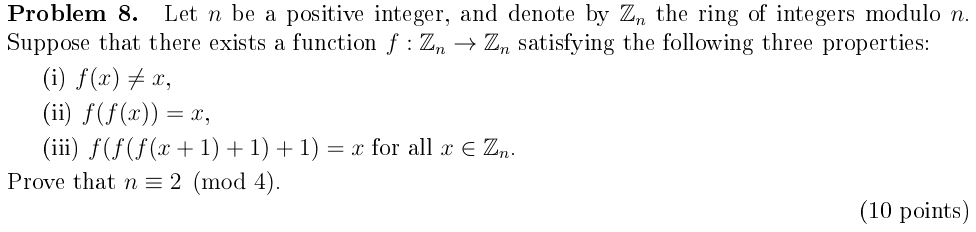
Let be a positive integer, and denote by the ring of integers modulo . Suppose that there exists a function satisfying the following three properties:
(i) ,
(ii) ,
(iii) for all .
Prove that .
Πρωτότυπο από το επίσημο PDF
Η μεταγραφή συγκρίθηκε σύμβολο προς σύμβολο με το πρωτότυπο, όχι ακόμα από άνθρωπο.
Δούλεψε τουλάχιστον 45 λεπτά πριν ανοίξεις τη λύση.
Επίσημη λύση
(Proposed by Ander Lamaison Vidarte, Berlin Mathematical School, Germany)
Solution. From property (ii) we can see that is surjective, so is a permutation of the elements in , and its order is at most . Therefore, the permutation is the product of disjoint transpositions of the form . Property (i) yields that this permutation has no fixed point, so is be even, and the number of transpositions is precisely .
Consider the permutation . If was odd then also would be odd. But property (iii) constraints that is the identity which is even. So cannot be odd; must be even. The cyclic permutation has order , an even number, so is odd. Then is odd. Since is the product of transpositions, this shows that must be odd, so .
Remark. There exists a function with properties (i–iii) for every . For take , . Here we outline a possible construction for .
Let , take a regular polygon with sides, and divide it into triangles with diagonals. Draw a circle that intersects each side and each diagonal twice; altogether we have intersections. Label the intersection points clockwise around the circle. On every side and diagonal we have two intersections; let send them to each other.
This function obviously satisfies properties (i) and (ii). For every we either have or the effect of adding and taking three times is going around the three sides of a triangle, so this function satisfies property (iii).
[Figure in the original PDF.]
Μεταγραφή από το επίσημο κείμενο λύσεων, σελίδα 2. Η μεταγραφή δεν έχει ελεγχθεί δεύτερη φορά· αν έχεις αμφιβολία, κοίτα το πρωτότυπο.
Θέμα αρχείου: η εκφώνηση είναι το επίσημο κείμενο (μεταγραμμένο, με το πρωτότυπο παραπάνω). Η ταξινόμηση ανά αντικείμενο και η δυσκολία εκτιμήθηκαν αυτόματα· υποδείξεις και λύση στα ελληνικά προστίθενται σταδιακά.
Πώς πήγε;
Οι κινήσεις που σημειώνεις επιστρέφουν νωρίτερα στη διαλογή.