IMC 2017, Ημέρα 1, Θέμα 2
Let be a differentiable function, and suppose that there exists a constant such that
for all . Prove that
holds for all .
Πρωτότυπο από το επίσημο PDF
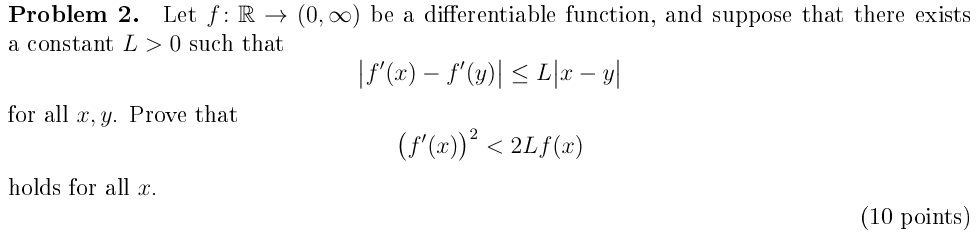
Η μεταγραφή συγκρίθηκε σύμβολο προς σύμβολο με το πρωτότυπο, όχι ακόμα από άνθρωπο.
Δούλεψε τουλάχιστον 45 λεπτά πριν ανοίξεις τη λύση.
Επίσημη λύση
(Proposed by Jan Šustek, University of Ostrava)
Solution. Notice that satisfies the Lipschitz-property, so is continuous and therefore locally integrable.
Consider an arbitrary and let . We need to prove .
If then the statement is trivial.
If then the condition provides ; this estimate is positive for . By integrating over that interval,
If then apply and repeat the same argument as
Μεταγραφή από το επίσημο κείμενο λύσεων, σελίδες 1–2. Η μεταγραφή δεν έχει ελεγχθεί δεύτερη φορά· αν έχεις αμφιβολία, κοίτα το πρωτότυπο.
Θέμα αρχείου: η εκφώνηση είναι το επίσημο κείμενο (μεταγραμμένο, με το πρωτότυπο παραπάνω). Η ταξινόμηση ανά αντικείμενο και η δυσκολία εκτιμήθηκαν αυτόματα· υποδείξεις και λύση στα ελληνικά προστίθενται σταδιακά.
Πώς πήγε;
Οι κινήσεις που σημειώνεις επιστρέφουν νωρίτερα στη διαλογή.