(Proposed by Alexandr Bolbot, Novosibirsk State University)
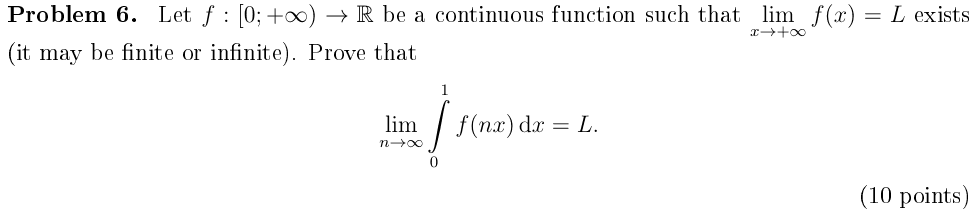
Solution 1. Case 1: L L L Take an arbitrary ε > 0 \varepsilon > 0 ε > 0 K ≥ 0 K\ge 0 K ≥ 0 ∣ ∫ 0 1 f ( n x ) d x − L ∣ < ε \left|\int\limits_0^1 f(nx)\,\mathrm{d}x - L\right| < \varepsilon 0 ∫ 1 f ( n x ) d x − L < ε
Since lim x → + ∞ f ( x ) = L \lim\limits_{x\to+\infty} f(x) = L x → + ∞ lim f ( x ) = L K 1 ≥ 0 K_1\ge 0 K 1 ≥ 0 ∣ f ( x ) − L ∣ < ε 2 \big|f(x)-L\big| < \frac{\varepsilon}{2} f ( x ) − L < 2 ε x ≥ K 1 x\ge K_1 x ≥ K 1 n ≥ K 1 n\ge K_1 n ≥ K 1
∣ ∫ 0 1 f ( n x ) d x − L ∣ = ∣ 1 n ∫ 0 n f ( x ) d x − L ∣ = 1 n ∣ ∫ 0 n ( f − L ) ∣ ≤ ≤ 1 n ∫ 0 n ∣ f − L ∣ = 1 n ( ∫ 0 K 1 ∣ f − L ∣ + ∫ K 1 n ∣ f − L ∣ ) < 1 n ( ∫ 0 K 1 ∣ f − L ∣ + ∫ K 1 n ε 2 ) = = 1 n ∫ 0 K 1 ∣ f − L ∣ + n − K 1 n ⋅ ε 2 < 1 n ∫ 0 K 1 ∣ f − L ∣ + ε 2 . \begin{aligned}
\left|\int_0^1 f(nx)\,\mathrm{d}x - L\right| &= \left|\frac{1}{n}\int_0^n f(x)\,\mathrm{d}x - L\right| = \frac{1}{n}\left|\int_0^n \big(f-L\big)\right| \le \\
\le \frac{1}{n}\int_0^n |f-L| &= \frac{1}{n}\left(\int_0^{K_1}|f-L| + \int_{K_1}^n |f-L|\right) < \frac{1}{n}\left(\int_0^{K_1}|f-L| + \int_{K_1}^n \frac{\varepsilon}{2}\right) = \\
&= \frac{1}{n}\int_0^{K_1}|f-L| + \frac{n-K_1}{n}\cdot\frac{\varepsilon}{2} < \frac{1}{n}\int_0^{K_1}|f-L| + \frac{\varepsilon}{2}.
\end{aligned} ∫ 0 1 f ( n x ) d x − L ≤ n 1 ∫ 0 n ∣ f − L ∣ = n 1 ∫ 0 n f ( x ) d x − L = n 1 ∫ 0 n ( f − L ) ≤ = n 1 ( ∫ 0 K 1 ∣ f − L ∣ + ∫ K 1 n ∣ f − L ∣ ) < n 1 ( ∫ 0 K 1 ∣ f − L ∣ + ∫ K 1 n 2 ε ) = = n 1 ∫ 0 K 1 ∣ f − L ∣ + n n − K 1 ⋅ 2 ε < n 1 ∫ 0 K 1 ∣ f − L ∣ + 2 ε . If n ≥ K 2 = 2 ε ∫ 0 K 1 ∣ f − L ∣ n\ge K_2 = \frac{2}{\varepsilon}\int_0^{K_1}|f-L| n ≥ K 2 = ε 2 ∫ 0 K 1 ∣ f − L ∣ ε 2 \frac{\varepsilon}{2} 2 ε x ≥ K : = max ( K 1 , K 2 ) x\ge K := \max(K_1,K_2) x ≥ K := max ( K 1 , K 2 )
∣ ∫ 0 1 f ( n x ) d x − L ∣ < ε 2 + ε 2 = ε . \left|\int_0^1 f(nx)\,\mathrm{d}x - L\right| < \frac{\varepsilon}{2} + \frac{\varepsilon}{2} = \varepsilon. ∫ 0 1 f ( n x ) d x − L < 2 ε + 2 ε = ε . Case 2: L = + ∞ L = +\infty L = + ∞ Take an arbitrary real M M M K ≥ 0 K\ge 0 K ≥ 0 ∫ 0 1 f ( n x ) d x > M \int\limits_0^1 f(nx)\,\mathrm{d}x > M 0 ∫ 1 f ( n x ) d x > M x ≥ K x\ge K x ≥ K
Since lim x → + ∞ f ( x ) = ∞ \lim\limits_{x\to+\infty} f(x) = \infty x → + ∞ lim f ( x ) = ∞ K 1 ≥ 0 K_1\ge 0 K 1 ≥ 0 f ( x ) > M + 1 f(x) > M+1 f ( x ) > M + 1 x ≥ K 1 x\ge K_1 x ≥ K 1 n ≥ 2 K 1 n\ge 2K_1 n ≥ 2 K 1
∫ 0 1 f ( n x ) d x = 1 n ∫ 0 n f ( x ) d x = 1 n ∫ 0 n f = 1 n ( ∫ 0 K 1 f + ∫ K 1 n f ) = = 1 n ( ∫ 0 K 1 f + ∫ K 1 n ( M + 1 ) ) = 1 n ( ∫ 0 K 1 f − K 1 ( M + 1 ) ) + M + 1. \begin{aligned}
\int_0^1 f(nx)\,\mathrm{d}x &= \frac{1}{n}\int_0^n f(x)\,\mathrm{d}x = \frac{1}{n}\int_0^n f = \frac{1}{n}\left(\int_0^{K_1} f + \int_{K_1}^n f\right) = \\
&= \frac{1}{n}\left(\int_0^{K_1} f + \int_{K_1}^n (M+1)\right) = \frac{1}{n}\left(\int_0^{K_1} f - K_1(M+1)\right) + M + 1.
\end{aligned} ∫ 0 1 f ( n x ) d x = n 1 ∫ 0 n f ( x ) d x = n 1 ∫ 0 n f = n 1 ( ∫ 0 K 1 f + ∫ K 1 n f ) = = n 1 ( ∫ 0 K 1 f + ∫ K 1 n ( M + 1 ) ) = n 1 ( ∫ 0 K 1 f − K 1 ( M + 1 ) ) + M + 1. If n ≥ K 2 : = ∣ ∫ 0 K 1 f − K 1 ( M + 1 ) ∣ n\ge K_2 := \left|\int_0^{K_1} f - K_1(M+1)\right| n ≥ K 2 := ∫ 0 K 1 f − K 1 ( M + 1 ) − 1 -1 − 1 x ≥ K : = max ( K 1 , K 2 ) x\ge K := \max(K_1,K_2) x ≥ K := max ( K 1 , K 2 ) ∫ 0 1 f ( n x ) d x > M \int_0^1 f(nx)\,\mathrm{d}x > M ∫ 0 1 f ( n x ) d x > M
Case 3: L = − ∞ L = -\infty L = − ∞ We can repeat the steps in Case 2 for the function − f -f − f
Solution 2. Let F ( x ) = ∫ 0 x f F(x) = \int_0^x f F ( x ) = ∫ 0 x f t > 0 t > 0 t > 0
∫ 0 1 f ( t x ) d x = F ( t ) t . \int_0^1 f(tx)\,\mathrm{d}x = \frac{F(t)}{t}. ∫ 0 1 f ( t x ) d x = t F ( t ) . Since lim t → ∞ t = ∞ \lim\limits_{t\to\infty} t = \infty t → ∞ lim t = ∞ lim t → ∞ F ′ ( t ) = lim t → ∞ f ( t ) = L \lim\limits_{t\to\infty} F'(t) = \lim\limits_{t\to\infty} f(t) = L t → ∞ lim F ′ ( t ) = t → ∞ lim f ( t ) = L lim t → ∞ F ( t ) t = lim t → ∞ F ′ ( t ) 1 = lim t → ∞ f ( t ) 1 = L \lim\limits_{t\to\infty}\frac{F(t)}{t} = \lim\limits_{t\to\infty}\frac{F'(t)}{1} = \lim\limits_{t\to\infty}\frac{f(t)}{1} = L t → ∞ lim t F ( t ) = t → ∞ lim 1 F ′ ( t ) = t → ∞ lim 1 f ( t ) = L lim F ( n ) n = L \lim\frac{F(n)}{n} = L lim n F ( n ) = L
Μεταγραφή από το επίσημο κείμενο λύσεων, σελίδες 1–2. Η μεταγραφή δεν έχει ελεγχθεί δεύτερη φορά· αν έχεις αμφιβολία, κοίτα το πρωτότυπο.