uniolympiads English

IMC 2020, Ημέρα 1, Θέμα 2

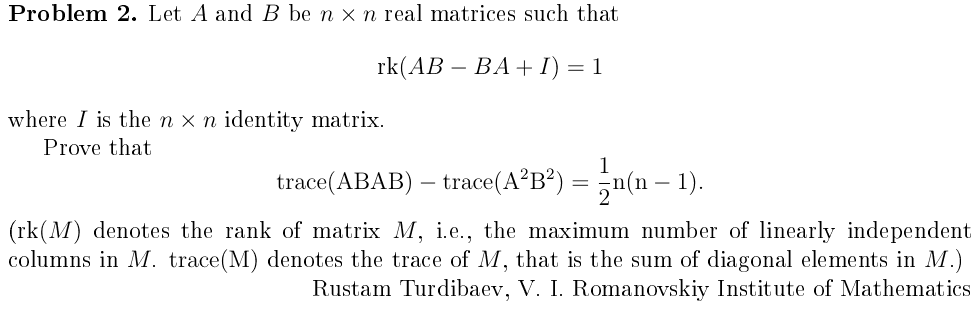
Let AA and BB be n×nn \times n real matrices such that

rk⁡(AB−BA+I)=1\operatorname{rk}(AB - BA + I) = 1

where II is the n×nn \times n identity matrix.

Prove that

trace⁡(ABAB)−trace⁡(A2B2)=12n(n−1).\operatorname{trace}(ABAB) - \operatorname{trace}(A^2B^2) = \frac{1}{2}n(n-1).

(rk⁡(M)\operatorname{rk}(M) denotes the rank of matrix MM, i.e., the maximum number of linearly independent columns in MM. trace⁡(M)\operatorname{trace}(M) denotes the trace of MM, that is the sum of diagonal elements in MM.)

Rustam Turdibaev, V. I. Romanovskiy Institute of Mathematics

Πρωτότυπο από το επίσημο PDFLet A and B be n × n real matrices such that rk (AB − BA + I) = 1 where I is the n × n identity matrix. Prove that 1 trace(ABAB) − trace(A 2 B 2 ) = n(n − 1). 2 (rk (M ) denotes the rank of matrix M , i.e., the maximum number of linearly independent columns in M . trace(M) denotes the trace of M , that is the sum of diagonal elements in M .) Rustam Turdibaev, V. I. Romanovskiy Institute of Mathematics

Η μεταγραφή συγκρίθηκε σύμβολο προς σύμβολο με το πρωτότυπο, όχι ακόμα από άνθρωπο.

Χρόνος σε αυτό το θέμα 0:00

Δούλεψε τουλάχιστον 45 λεπτά πριν ανοίξεις τη λύση.

Επίσημη λύση

Rustam Turdibaev, V. I. Romanovskiy Institute of Mathematics

Solution. Let X=AB−BAX = AB - BA. The first important observation is that

trace(X2)=trace(ABAB−ABBA−BAAB+BABA)=2trace(ABAB)−2trace(A2B2)\mathrm{trace(X^2) = trace(ABAB - ABBA - BAAB + BABA) = 2trace(ABAB) - 2trace(A^2B^2)}
using that the trace is cyclic. So we need to prove that trace(X2)=n(n−1)\mathrm{trace(X^2) = n(n-1)}.

By assumption, X+IX + I has rank one, so we can write X+I=vtwX + I = v^t w for two vectors v,wv, w. So

X2=(vtw−I)2=I−2vtw+vtwvtw=I+(wvt−2)vtw.X^2 = (v^t w - I)^2 = I - 2v^t w + v^t w v^t w = I + (w v^t - 2) v^t w.
Now by definition of XX we have trace(X)=0\mathrm{trace(X) = 0} and hence wvt=trace(wvt)=trace(vtw)=nw v^t = \mathrm{trace(wv^t) = trace(v^tw) = n} so that indeed
trace(X2)=n+(n−2)n=n(n−1).\mathrm{trace(X^2) = n + (n-2)n = n(n-1).}

An alternative way to use the rank one condition is via eigenvalues: Since X+IX + I has rank one, it has eigenvalue 00 with multiplicity n−1n-1. So XX has eigenvalue −1-1 with multiplicity n−1n-1. Since trace(X)=0\mathrm{trace(X) = 0} the remaining eigenvalue of XX must be n−1n-1. Hence

trace(X2)=(n−1)2+(n−1)⋅12=n(n−1).\mathrm{trace(X^2) = (n-1)^2 + (n-1) \cdot 1^2 = n(n-1).}

Μεταγραφή από το επίσημο κείμενο λύσεων, σελίδες 3–4. Η μεταγραφή δεν έχει ελεγχθεί δεύτερη φορά· αν έχεις αμφιβολία, κοίτα το πρωτότυπο.

Θέμα αρχείου: η εκφώνηση είναι το επίσημο κείμενο (μεταγραμμένο, με το πρωτότυπο παραπάνω). Η ταξινόμηση ανά αντικείμενο και η δυσκολία εκτιμήθηκαν αυτόματα· υποδείξεις και λύση στα ελληνικά προστίθενται σταδιακά.

Πώς πήγε;