IMC 2022, Ημέρα 2, Θέμα 7
Let be idempotent complex matrices such that
Prove that at least one of the given matrices has rank . (A matrix is called idempotent if .)
Πρωτότυπο από το επίσημο PDF
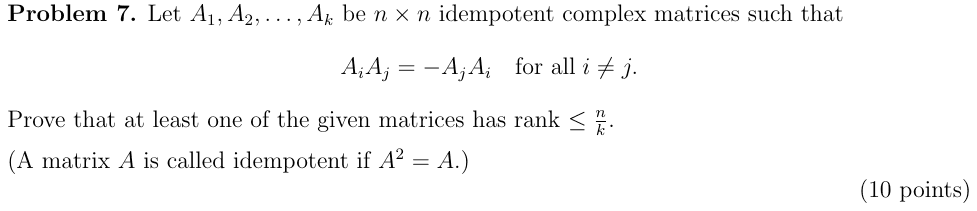
Η μεταγραφή συγκρίθηκε σύμβολο προς σύμβολο με το πρωτότυπο, όχι ακόμα από άνθρωπο.
Δούλεψε τουλάχιστον 45 λεπτά πριν ανοίξεις τη λύση.
Επίσημη λύση
(proposed by Danila Belousov, Novosibirsk)
Hint: Consider the trace and the rank of .
Solution 1.
Lemma. For any idempotent matrix
Proof. Observe that an idempotent matrix satisfies the equation . Hence the minimal polynomial is a product of linear factors and the matrix is diagonalizable. Therefore, the rank of the matrix equals the number of non-zero eigenvalues. Since the matrix has eigenvalues 0 or 1, this provides that the trace is equal to the number of unity eigenvalues, or non-zero eigenvalues.
It can be shown that is also an idempotent. Indeed,
Applying the lemma one can obtain
The required inequality follows.
Solution 2. We first prove that for idempotents with we already must have . Indeed, it is clear that for so it suffices to prove the same for , i.e. when . But then writing we have i.e. and hence so that again .
Henceforth, we can assume the stronger condition for all . We next claim that all the image spaces of are linearly independent. This will imply the claim, since then the sum of their dimensions can be at most , and so one of them has to be . Now, for the sake of contradiction, suppose that with and w.l.o.g. . But then
Remark. Here is a different argument for , without eigenvectors: multiplying by and using its idempotence and the super-commutativity , we have
Μεταγραφή από το επίσημο κείμενο λύσεων, σελίδες 3–4. Η μεταγραφή δεν έχει ελεγχθεί δεύτερη φορά· αν έχεις αμφιβολία, κοίτα το πρωτότυπο.
Θέμα αρχείου: η εκφώνηση είναι το επίσημο κείμενο (μεταγραμμένο, με το πρωτότυπο παραπάνω). Η ταξινόμηση ανά αντικείμενο και η δυσκολία εκτιμήθηκαν αυτόματα· υποδείξεις και λύση στα ελληνικά προστίθενται σταδιακά.
Πώς πήγε;
Οι κινήσεις που σημειώνεις επιστρέφουν νωρίτερα στη διαλογή.