IMC 2023, Ημέρα 2, Θέμα 6
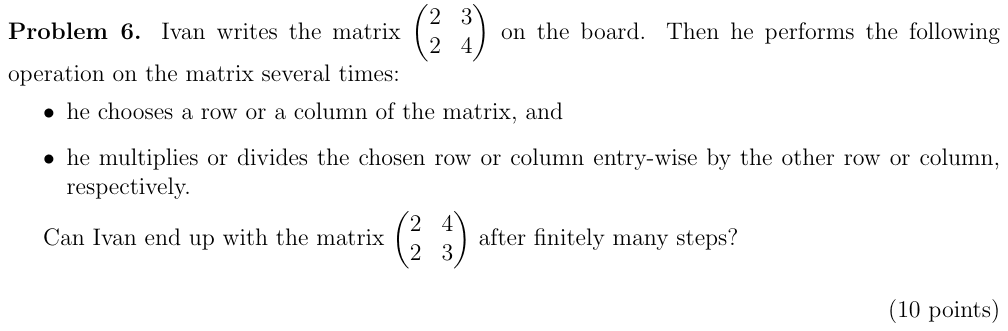
Ivan writes the matrix on the board. Then he performs the following operation on the matrix several times:
- he chooses a row or a column of the matrix, and
- he multiplies or divides the chosen row or column entry-wise by the other row or column, respectively.
Can Ivan end up with the matrix after finitely many steps?
Πρωτότυπο από το επίσημο PDF
Η μεταγραφή συγκρίθηκε σύμβολο προς σύμβολο με το πρωτότυπο, όχι ακόμα από άνθρωπο.
Δούλεψε τουλάχιστον 45 λεπτά πριν ανοίξεις τη λύση.
Επίσημη λύση
(proposed by Alex Avdiushenko, Neapolis University Paphos, Cyprus)
Hint: Construct an invariant quantity that does not change during Ivan's prcedure.
Solution. We show that starting from , Ivan cannot reach the matrix .
Notice first that the allowed operations preserve the positivity of entries; all matrices Ivan can reach have only positive entries.
For every matrix with positive entries, let . By taking logarithms of the entries, the steps in Ivan game will be replaced by adding or subtracting a row or column to the other row. Such standard row and column operations preserve the determinant.
Hence, if the matrices in the game are , then we have , and it suffices to verify that .
Indeed,
Μεταγραφή από το επίσημο κείμενο λύσεων, σελίδες 1–2. Η μεταγραφή δεν έχει ελεγχθεί δεύτερη φορά· αν έχεις αμφιβολία, κοίτα το πρωτότυπο.
Θέμα αρχείου: η εκφώνηση είναι το επίσημο κείμενο (μεταγραμμένο, με το πρωτότυπο παραπάνω). Η ταξινόμηση ανά αντικείμενο και η δυσκολία εκτιμήθηκαν αυτόματα· υποδείξεις και λύση στα ελληνικά προστίθενται σταδιακά.
Πώς πήγε;
Οι κινήσεις που σημειώνεις επιστρέφουν νωρίτερα στη διαλογή.