IMC 2024, Ημέρα 1, Θέμα 5
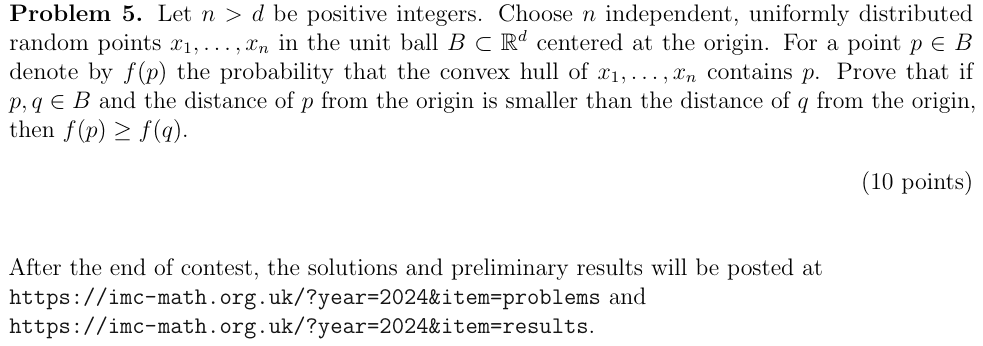
Let be positive integers. Choose independent, uniformly distributed random points in the unit ball centered at the origin. For a point denote by the probability that the convex hull of contains . Prove that if and the distance of from the origin is smaller than the distance of from the origin, then .
Πρωτότυπο από το επίσημο PDF
Η μεταγραφή συγκρίθηκε σύμβολο προς σύμβολο με το πρωτότυπο, όχι ακόμα από άνθρωπο.
Δούλεψε τουλάχιστον 45 λεπτά πριν ανοίξεις τη λύση.
Επίσημη λύση
(proposed by Fedor Petrov, St Petersburg State University)
Solution. By radial symmetry of the distribution, depends only on (the distance between and ), so, we may assume that lies on the segment between and . For points and denote by the indicator function of the event " is in the convex hull of ". The claim follows from the following deterministic inequality
To prove (1), we use the following formula for the characteristic function of the convex polyhedron : if are all facets of , and is the convex hull of and , then , where the sign is plus if and are on the same side of , and minus otherwise. Indeed, for every point in general position look how the ray intersects the boundary of and realize that for at most two summands the contribution of the RHS at point is non-zero, and the total contribution equals 1 when is inside and 0 (possibly as ) otherwise. Use this formula for every polyhedron with vertices , where each is . These polyhedrons are simplicial (all facets are simplices) because of the general position condition. Sum up over all such , we get the expression of as a linear combination of , where are simplices formed by and some points in (not containing and simultaneously).
For proving (1), it suffices to verify that all coefficients of in this linear combination are positive (since two sides of (1) are the values of the sum at and ). Let's find a coefficient of , where, say, is a simplex with vertices . The plane through partitions onto two parts (containing ) and (not containing ). For every pair with , either both points belong to , or one belongs to and another to . goes with the plus sign for with vertices and other vertices from , and with the minus sign for with vertices and other vertices from . It is immediate that there are at least as many pluses as minuses.
Μεταγραφή από το επίσημο κείμενο λύσεων, σελίδα 5. Η μεταγραφή δεν έχει ελεγχθεί δεύτερη φορά· αν έχεις αμφιβολία, κοίτα το πρωτότυπο.
Θέμα αρχείου: η εκφώνηση είναι το επίσημο κείμενο (μεταγραμμένο, με το πρωτότυπο παραπάνω). Η ταξινόμηση ανά αντικείμενο και η δυσκολία εκτιμήθηκαν αυτόματα· υποδείξεις και λύση στα ελληνικά προστίθενται σταδιακά.
Πώς πήγε;
Οι κινήσεις που σημειώνεις επιστρέφουν νωρίτερα στη διαλογή.