IMC 2024, Ημέρα 2, Θέμα 9
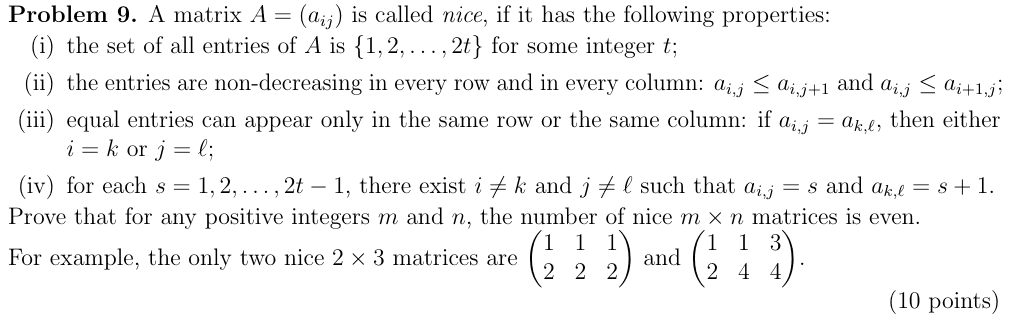
A matrix is called nice, if it has the following properties:
(i) the set of all entries of is for some integer ;
(ii) the entries are non-decreasing in every row and in every column: and ;
(iii) equal entries can appear only in the same row or the same column: if , then either or ;
(iv) for each , there exist and such that and .
Prove that for any positive integers and , the number of nice matrices is even. For example, the only two nice matrices are and .
Πρωτότυπο από το επίσημο PDF
Η μεταγραφή συγκρίθηκε σύμβολο προς σύμβολο με το πρωτότυπο, όχι ακόμα από άνθρωπο.
Δούλεψε τουλάχιστον 45 λεπτά πριν ανοίξεις τη λύση.
Επίσημη λύση
(proposed by Fedor Petrov, St Petersburg State University)
Solution. Define a standard Young tableaux of shape as an matrix with the set of entries , increasing in every row and in every column as in (ii).
Call two standard Young tableaux friends, if they differ by a switch of two consecutive numbers (the places of and must be not neighbouring, for such a switch preserving the monotonicity in rows and columns).
For a nice matrix we construct a standard Young tableaux of shape as follows: if has entries equal to , we replace them by the numbers from to preserving monotonicity.
Note that our has exactly friends, where is the number of distinct entries in , and moreover, every standard Young tableaux with odd number of friends corresponds to a unique nice matrix. It remains to apply the handshaking lemma (i.e., the sum of the degrees equals twice the number of edges in this graph).
Μεταγραφή από το επίσημο κείμενο λύσεων, σελίδες 4–5. Η μεταγραφή δεν έχει ελεγχθεί δεύτερη φορά· αν έχεις αμφιβολία, κοίτα το πρωτότυπο.
Θέμα αρχείου: η εκφώνηση είναι το επίσημο κείμενο (μεταγραμμένο, με το πρωτότυπο παραπάνω). Η ταξινόμηση ανά αντικείμενο και η δυσκολία εκτιμήθηκαν αυτόματα· υποδείξεις και λύση στα ελληνικά προστίθενται σταδιακά.
Πώς πήγε;
Οι κινήσεις που σημειώνεις επιστρέφουν νωρίτερα στη διαλογή.