uniolympiads English

IMC 2025, Ημέρα 2, Θέμα 8

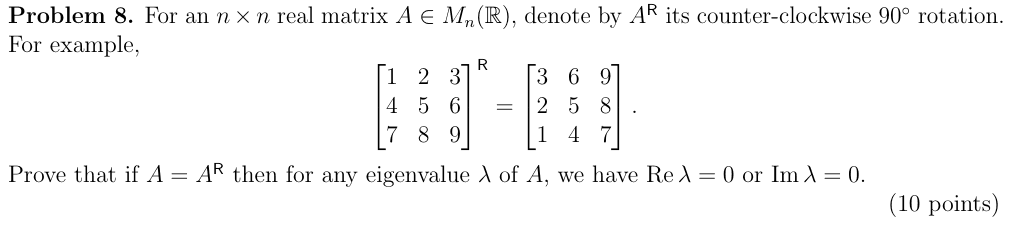
For an n×nn \times n real matrix A∈Mn(R)A \in M_n(\mathbb{R}), denote by ARA^{\mathsf{R}} its counter-clockwise 90∘90^\circ rotation. For example,

[123456789]R=[369258147].\begin{bmatrix} 1 & 2 & 3 \\ 4 & 5 & 6 \\ 7 & 8 & 9 \end{bmatrix}^{\mathsf{R}} = \begin{bmatrix} 3 & 6 & 9 \\ 2 & 5 & 8 \\ 1 & 4 & 7 \end{bmatrix}.

Prove that if A=ARA = A^{\mathsf{R}} then for any eigenvalue λ\lambda of AA, we have Re⁡λ=0\operatorname{Re}\lambda = 0 or Im⁡λ=0\operatorname{Im}\lambda = 0.

Πρωτότυπο από το επίσημο PDFFor an n × n real matrix A ∈ M n (R), denote by A R its counter-clockwise 90 ◦ rotation. For example,   R   1 2 3 3 6 9  4 5 6  =  2 5 8  . 7 8 9 1 4 7 Prove that if A = A R then for any eigenvalue λ of A, we have Re λ = 0 or Im λ = 0.

Η μεταγραφή συγκρίθηκε σύμβολο προς σύμβολο με το πρωτότυπο, όχι ακόμα από άνθρωπο.

Χρόνος σε αυτό το θέμα 0:00

Δούλεψε τουλάχιστον 45 λεπτά πριν ανοίξεις τη λύση.

Επίσημη λύση

(proposed by Jan Kuś, University of Warwick)

Solution. If λ=0\lambda = 0, the claim holds as 0∈R0 \in \mathbb{R}. Assume λ≠0\lambda \ne 0 is an eigenvalue of AA with a corresponding eigenvector x∈Cn∖{0}x \in \mathbb{C}^n \setminus \{0\}.

We will first express the operation A↦ARA \mapsto A^{\mathsf{R}} algebraically. The element at position (i,j)(i, j) in AA ends up at position (n+1−j,i)(n + 1 - j, i) in ARA^{\mathsf{R}}. Thus, the rotation is defined by the relation (AR)i,j=Aj,n+1−i(A^{\mathsf{R}})_{i,j} = A_{j,n+1-i}.

Let JJ be the matrix where Ji,j=δin+1−jJ_{i,j} = \delta_i^{n+1-j}. The operation of transposing AA and then reversing the rows gives the matrix JA⊤JA^\top. The (i,j)(i, j)-th element of this matrix is

(JA⊤)i,j=∑k=1nJi,k(A⊤)k,j=(A⊤)n+1−i,j=Aj,n+1−i.(JA^\top)_{i,j} = \sum_{k=1}^{n} J_{i,k}(A^\top)_{k,j} = (A^\top)_{n+1-i,j} = A_{j,n+1-i}.
This matches the definition of ARA^{\mathsf{R}}, so we get the identity AR=JA⊤A^{\mathsf{R}} = JA^\top. Note that the matrix JJ is symmetric (J=J⊤J = J^\top) and it is its own inverse (J2=IJ^2 = I).

The given condition A=ARA = A^{\mathsf{R}} thus means A=JA⊤A = JA^\top. Left-multiplying by JJ yields

JA=J(JA⊤)=(J2)A⊤=A⊤.(∗)JA = J(JA^\top) = (J^2)A^\top = A^\top. \tag{$*$}

Now, consider the standard Hermitian inner product (u,v)=v∗u(u, v) = v^*u on Cn\mathbb{C}^n. We evaluate (Ax,Ax)(Ax, Ax) in two ways. First, using our choice of xx as an eigenvector corresponding to λ\lambda:

(Ax,Ax)=(λx,λx)=∣λ∣2∥x∥2.(Ax, Ax) = (\lambda x, \lambda x) = |\lambda|^2\|x\|^2.
Second, using the adjoint property and (∗)(*):
(Ax,Ax)=(A∗Ax,x)=(A⊤Ax,x)=(JA(λx),x)=λ(JAx,x)=λ2(Jx,x).(Ax, Ax) = (A^*Ax, x) = (A^\top Ax, x) = (JA(\lambda x), x) = \lambda(JAx, x) = \lambda^2(Jx, x).
Together, these give us ∣λ∣2∥x∥2=λ2(Jx,x)|\lambda|^2\|x\|^2 = \lambda^2(Jx, x).

The term (Jx,x)(Jx, x) is real, since (Jx,x)∗=(J∗x,x)=(Jx,x)(Jx, x)^* = (J^*x, x) = (Jx, x) because JJ is real and symmetric. Since λ≠0\lambda \ne 0 and x≠0x \ne 0, the left side ∣λ∣2∥x∥2|\lambda|^2\|x\|^2 is a positive real number. This implies that λ2(x,Jx)\lambda^2(x, Jx) must also be a positive real number. And as (x,Jx)(x, Jx) is real, so is λ2\lambda^2.

Thus, either λ\lambda is real (if λ2>0\lambda^2 > 0) or its real part is 00 (if λ2<0\lambda^2 < 0). This completes the proof.

Μεταγραφή από το επίσημο κείμενο λύσεων, σελίδες 3–4. Η μεταγραφή δεν έχει ελεγχθεί δεύτερη φορά· αν έχεις αμφιβολία, κοίτα το πρωτότυπο.

Θέμα αρχείου: η εκφώνηση είναι το επίσημο κείμενο (μεταγραμμένο, με το πρωτότυπο παραπάνω). Η ταξινόμηση ανά αντικείμενο και η δυσκολία εκτιμήθηκαν αυτόματα· υποδείξεις και λύση στα ελληνικά προστίθενται σταδιακά.

Πώς πήγε;