uniolympiads English

SEEMOUS 2022, Θέμα 1

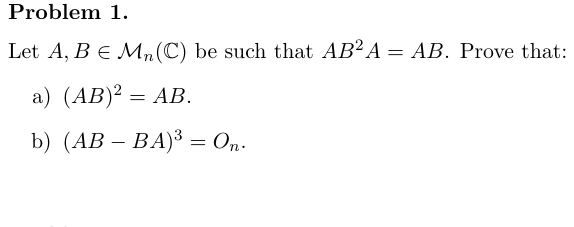
Let A,B∈Mn(C)A, B \in \mathcal{M}_n(\mathbb{C}) be such that AB2A=ABAB^2A = AB. Prove that:

a) (AB)2=AB(AB)^2 = AB.

b) (AB−BA)3=On(AB - BA)^3 = O_n.

Πρωτότυπο από το επίσημο PDFLet A, B ∈ M n (C) be such that AB 2 A = AB. Prove that: a) (AB) 2 = AB. b) (AB − BA) 3 = O n .

Η μεταγραφή συγκρίθηκε σύμβολο προς σύμβολο με το πρωτότυπο, όχι ακόμα από άνθρωπο.

Χρόνος σε αυτό το θέμα 0:00

Δούλεψε τουλάχιστον 45 λεπτά πριν ανοίξεις τη λύση.

Επίσημη λύση

Solution: From the hypotesis, AB(BA−In)=OnAB(BA - I_n) = O_n. Based on Sylvester's inequality for ranks, it follows that

rank⁡(AB)+rank⁡(BA−In)⩽n+rank⁡(AB(BA−In))=n.(1)\operatorname{rank}(AB) + \operatorname{rank}(BA - I_n) \leqslant n + \operatorname{rank}\left(AB(BA - I_n)\right) = n. \tag{1}
Also, it is true in general that
rank⁡(AB−In)=rank⁡(BA−In),(2)\operatorname{rank}(AB - I_n) = \operatorname{rank}(BA - I_n), \tag{2}
so
rank⁡(AB−In)+rank⁡(AB)⩽n.(3)\operatorname{rank}(AB - I_n) + \operatorname{rank}(AB) \leqslant n. \tag{3}
But Ker⁡(AB−In)⊆Im⁡AB\operatorname{Ker}(AB - I_n)\subseteq\operatorname{Im} AB, so
rank⁡(AB−In)+rank⁡(AB)=n+rank⁡((AB)2−AB)(4)\operatorname{rank}(AB - I_n) + \operatorname{rank}(AB) = n + \operatorname{rank}\left((AB)^2 - AB\right) \tag{4}
(this is the equality case in Sylvester's inequality for the matrices AB−InAB - I_n and ABAB). Combining (3) and (4), it follows that (AB)2=AB(AB)^2 = AB.

Using now the identity from the hypotesis and (AB)2=AB(AB)^2 = AB, we obtain

(AB−BA)2=(AB)2+(BA)2−AB2A−BA2B=(BA)2−BA2B=−BA(AB−BA)(AB−BA)3=−BA(AB−BA)2=(BA)2(AB−BA)(AB−BA)4=(BA)2(AB−BA)2=−(BA)3(AB−BA)=−B(AB)2A(AB−BA)=−B(AB)A(AB−BA)=−(BA)2(AB−BA)=−(AB−BA)3,\begin{aligned} (AB - BA)^2 &= (AB)^2 + (BA)^2 - AB^2A - BA^2B = (BA)^2 - BA^2B = -BA(AB - BA) \\ (AB - BA)^3 &= -BA(AB - BA)^2 = (BA)^2(AB - BA) \\ (AB - BA)^4 &= (BA)^2(AB - BA)^2 = -(BA)^3(AB - BA) = -B(AB)^2A(AB - BA) \\ &= -B(AB)A(AB - BA) = -(BA)^2(AB - BA) \\ &= -(AB - BA)^3, \end{aligned}
hence (AB−BA)4=−(AB−BA)3(AB - BA)^4 = -(AB - BA)^3.

Let λ\lambda be any eigenvalue of AB−BAAB - BA. Then the previous identity implies λ4=−λ3\lambda^4 = -\lambda^3, so λ∈{0,−1}\lambda\in\{0,-1\}. Since Tr⁡(AB−BA)=0\operatorname{Tr}(AB - BA) = 0, it follows that all eigenvalues of AB−BAAB - BA must be 00. Then (AB−BA)n=On(AB - BA)^n = O_n, and hence, (AB−BA)3=On(AB - BA)^3 = O_n.

Μεταγραφή από το επίσημο κείμενο λύσεων, σελίδες 1–2. Η μεταγραφή δεν έχει ελεγχθεί δεύτερη φορά· αν έχεις αμφιβολία, κοίτα το πρωτότυπο.
Θέμα αρχείου: η εκφώνηση είναι το επίσημο κείμενο (μεταγραμμένο, με το πρωτότυπο παραπάνω). Η ταξινόμηση ανά αντικείμενο και η δυσκολία εκτιμήθηκαν αυτόματα· υποδείξεις και λύση στα ελληνικά προστίθενται σταδιακά.

Πώς πήγε;