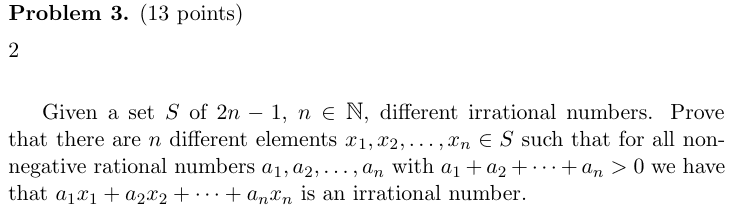
Solution. Let I be the set of irrational numbers, Q – the set of rational numbers, Q+=Q∩[0,∞). We work by induction. For n=1 the statement is trivial. Let it be true for n−1. We start to prove it for n. From the induction argument there are n−1 different elements x1,x2,…,xn−1∈S such that
a1x1+a2x2+⋯+an−1xn−1∈Ifor all a1,a2,…,an∈Q+ with a1+a2+⋯+an−1>0.(1)
Denote the other elements of
S by
xn,xn+1,…,x2n−1. Assume the statement is not true for
n. Then for
k=0,1,…,n−1 there are
rk∈Q such that
i=1∑n−1bikxi+ckxn+k=rk for some bik,ck∈Q+, i=1∑n−1bik+ck>0.(2)
Also
k=0∑n−1dkxn+k=R for some dk∈Q+, k=0∑n−1dk>0,R∈Q.(3)
If in (2)
ck=0 then (2) contradicts (1). Thus
ck=0 and without loss of generality one may take
ck=1. In (2) also
i=1∑n−1bik>0 in view of
xn+k∈I. Replacing (2) in (3) we get
k=0∑n−1dk(−i=1∑n−1bikxi+rk)=R or i=1∑n−1(k=0∑n−1dkbik)xi∈Q,
which contradicts (1) because of the conditions on
b′s and
d′s.
Transcribed from the official solutions, page 3. This transcription has not been checked a second time; if in doubt, look at the original.