uniolympiads Ελληνικά

IMC 1994, Day 1, Problem 5

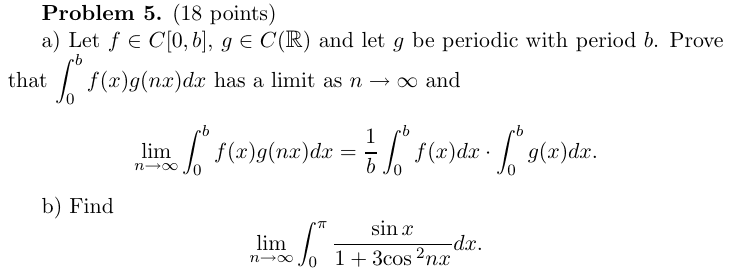
a) Let f∈C[0,b]f \in C[0, b], g∈C(R)g \in C(\mathbb{R}) and let gg be periodic with period bb. Prove that ∫0bf(x)g(nx) dx\int_0^b f(x)g(nx)\,dx has a limit as n→∞n \to \infty and

lim⁡n→∞∫0bf(x)g(nx) dx=1b∫0bf(x) dx⋅∫0bg(x) dx.\lim_{n \to \infty} \int_0^b f(x)g(nx)\,dx = \frac{1}{b}\int_0^b f(x)\,dx \cdot \int_0^b g(x)\,dx.

b) Find

lim⁡n→∞∫0πsin⁡x1+3cos⁡2nx dx.\lim_{n \to \infty} \int_0^{\pi} \frac{\sin x}{1 + 3\cos^2 nx}\,dx.
Original from the official PDF(18 points) a) Let f ∈ C[0, b], g ∈ C( R ) and let g be periodic with period b. Prove that Z b f (x)g(nx)dx has a limit as n → ∞ and 0 lim Z b n→∞ 0 f (x)g(nx)dx = b) Find Z b f (x)dx · 0 lim Z π n→∞ 0 1 b Z b g(x)dx. 0 sin x dx. 1 + 3cos 2 nx

This transcription was compared symbol by symbol with the original, but not yet by a person.

Time on this problem 0:00

Work for at least 45 minutes before opening the solution.

Official solution

Solution. Set ∥g∥1=∫0b∣g(x)∣dx\|g\|_1=\displaystyle\int_0^b|g(x)|dx and

ω(f,t)=sup⁡{∣f(x)−f(y)∣ : x,y∈[0,b], ∣x−y∣≤t}.\omega(f,t)=\sup\left\{|f(x)-f(y)|\ :\ x,y\in[0,b],\ |x-y|\le t\right\}.
In view of the uniform continuity of ff we have ω(f,t)→0\omega(f,t)\to 0 as t→0t\to 0. Using the periodicity of gg we get
∫0bf(x)g(nx)dx=∑k=1n∫b(k−1)/nbk/nf(x)g(nx)dx=∑k=1nf(bk/n)∫b(k−1)/nbk/ng(nx)dx+∑k=1n∫b(k−1)/nbk/n{f(x)−f(bk/n)}g(nx)dx=1n∑k=1nf(bk/n)∫0bg(x)dx+O(ω(f,b/n)∥g∥1)=1b∑k=1n∫b(k−1)/nbk/nf(x)dx∫0bg(x)dx+1b∑k=1n(bnf(bk/n)−∫b(k−1)/nbk/nf(x)dx)∫0bg(x)dx+O(ω(f,b/n)∥g∥1)=1b∫0bf(x)dx∫0bg(x)dx+O(ω(f,b/n)∥g∥1).\begin{aligned}&\int_0^bf(x)g(nx)dx=\sum_{k=1}^n\int_{b(k-1)/n}^{bk/n}f(x)g(nx)dx\\ &=\sum_{k=1}^nf(bk/n)\int_{b(k-1)/n}^{bk/n}g(nx)dx+\sum_{k=1}^n\int_{b(k-1)/n}^{bk/n}\{f(x)-f(bk/n)\}g(nx)dx\\ &=\frac{1}{n}\sum_{k=1}^nf(bk/n)\int_0^bg(x)dx+O(\omega(f,b/n)\|g\|_1)\\ &=\frac{1}{b}\sum_{k=1}^n\int_{b(k-1)/n}^{bk/n}f(x)dx\int_0^bg(x)dx\\ &\quad+\frac{1}{b}\sum_{k=1}^n\left(\frac{b}{n}f(bk/n)-\int_{b(k-1)/n}^{bk/n}f(x)dx\right)\int_0^bg(x)dx+O(\omega(f,b/n)\|g\|_1)\\ &=\frac{1}{b}\int_0^bf(x)dx\int_0^bg(x)dx+O(\omega(f,b/n)\|g\|_1).\end{aligned}
This proves a). For b) we set b=πb=\pi,  f(x)=sin⁡x\ f(x)=\sin x,  g(x)=(1+3cos⁡2x)−1\ g(x)=(1+3\cos^2x)^{-1}. From a) and
∫0πsin⁡xdx=2,∫0π(1+3cos⁡2x)−1dx=π2\int_0^\pi\sin xdx=2,\quad\int_0^\pi(1+3\cos^2x)^{-1}dx=\frac{\pi}{2}
we get
lim⁡n→∞∫0πsin⁡x1+3cos⁡2nxdx=1.\lim_{n\to\infty}\int_0^\pi\frac{\sin x}{1+3\cos^2nx}dx=1.

Transcribed from the official solutions, pages 4–5. This transcription has not been checked a second time; if in doubt, look at the original.
Archive problem: the statement is the official text (transcribed, with the original above). Subject classification and difficulty were estimated automatically; hints and a worked solution are added over time.

How did it go?