uniolympiads Ελληνικά

IMC 1995, Day 1, Problem 3

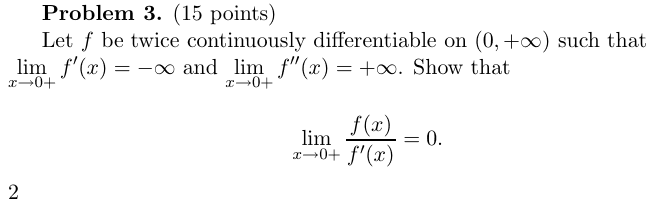
Let ff be twice continuously differentiable on (0,+∞)(0, +\infty) such that lim⁡x→0+f′(x)=−∞\lim_{x \to 0+} f'(x) = -\infty and lim⁡x→0+f′′(x)=+∞\lim_{x \to 0+} f''(x) = +\infty. Show that

lim⁡x→0+f(x)f′(x)=0.\lim_{x \to 0+} \frac{f(x)}{f'(x)} = 0.
Original from the official PDF(15 points) Let f be twice continuously differentiable on (0, +∞) such that lim f 0 (x) = −∞ and lim f 00 (x) = +∞. Show that x→0+ x→0+ f (x) = 0. x→0+ f 0 (x) lim 2

This transcription was compared symbol by symbol with the original, but not yet by a person.

Time on this problem 0:00

Work for at least 45 minutes before opening the solution.

Official solution

Solution. Since f′f' tends to −∞-\infty and f′′f'' tends to +∞+\infty as xx tends to 0+0+, there exists an interval (0,r)(0,r) such that f′(x)<0f'(x)<0 and f′′(x)>0f''(x)>0 for all x∈(0,r)x\in(0,r). Hence ff is decreasing and f′f' is increasing on (0,r)(0,r). By the mean value theorem for every 0<x<x0<r0<x<x_0<r we obtain

f(x)−f(x0)=f′(ξ)(x−x0)>0,f(x)-f(x_0)=f'(\xi)(x-x_0)>0,
for some ξ∈(x,x0)\xi\in(x,x_0). Taking into account that f′f' is increasing, f′(x)<f′(ξ)<0f'(x)<f'(\xi)<0, we get
x−x0<f′(ξ)f′(x)(x−x0)=f(x)−f(x0)f′(x)<0.x-x_0<\frac{f'(\xi)}{f'(x)}(x-x_0)=\frac{f(x)-f(x_0)}{f'(x)}<0.
Taking limits as xx tends to 0+0+ we obtain
−x0≤lim inf⁡x→0+f(x)f′(x)≤lim sup⁡x→0+f(x)f′(x)≤0.-x_0\le\liminf_{x\to0+}\frac{f(x)}{f'(x)}\le\limsup_{x\to0+}\frac{f(x)}{f'(x)}\le0.
Since this happens for all x0∈(0,r)x_0\in(0,r) we deduce that lim⁡x→0+f(x)f′(x)\displaystyle\lim_{x\to0+}\frac{f(x)}{f'(x)} exists and lim⁡x→0+f(x)f′(x)=0\displaystyle\lim_{x\to0+}\frac{f(x)}{f'(x)}=0.

Transcribed from the official solutions, page 3. This transcription has not been checked a second time; if in doubt, look at the original.

Archive problem: the statement is the official text (transcribed, with the original above). Subject classification and difficulty were estimated automatically; hints and a worked solution are added over time.

How did it go?