uniolympiads Ελληνικά

IMC 1997, Day 1, Problem 1

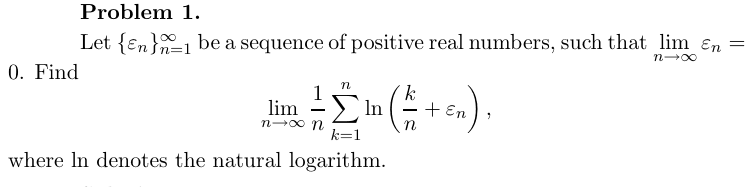
Let {εn}n=1∞\{\varepsilon_n\}_{n=1}^{\infty} be a sequence of positive real numbers, such that lim⁡n→∞εn=0\lim_{n \to \infty} \varepsilon_n = 0. Find

lim⁡n→∞1n∑k=1nln⁡(kn+εn),\lim_{n \to \infty} \frac{1}{n} \sum_{k=1}^{n} \ln\left(\frac{k}{n} + \varepsilon_n\right),

where ln⁡\ln denotes the natural logarithm.

Original from the official PDF0. Find Problem 1. Let {ε n } ∞ n=1 be a sequence of positive real numbers, such that lim ε n = n→∞ lim 1 n→∞ n n X ln k=1 k + ε n , n where ln denotes the natural logarithm.

This transcription was compared symbol by symbol with the original, but not yet by a person.

Time on this problem 0:00

Work for at least 45 minutes before opening the solution.

Official solution

Solution. It is well known that

−1=∫01ln⁡xdx=lim⁡n→∞1n∑k=1nln⁡(kn)-1 = \int_0^1 \ln x dx = \lim_{n\to\infty} \frac1n \sum_{k=1}^n \ln\left(\frac kn\right)
(Riemman's sums). Then
1n∑k=1nln⁡(kn+εn)≥1n∑k=1nln⁡(kn)⟶n→∞−1.\frac1n \sum_{k=1}^n \ln\left(\frac kn + \varepsilon_n\right) \ge \frac1n \sum_{k=1}^n \ln\left(\frac kn\right) \underset{n\to\infty}{\longrightarrow} -1.
Given ε>0\varepsilon > 0 there exist n0n_0 such that 0<εn≤ε0 < \varepsilon_n \le \varepsilon for all n≥n0n \ge n_0. Then
1n∑k=1nln⁡(kn+εn)≤1n∑k=1nln⁡(kn+ε).\frac1n \sum_{k=1}^n \ln\left(\frac kn + \varepsilon_n\right) \le \frac1n \sum_{k=1}^n \ln\left(\frac kn + \varepsilon\right).
Since
lim⁡n→∞1n∑k=1nln⁡(kn+ε)=∫01ln⁡(x+ε)dx=∫ε1+εln⁡xdx\begin{aligned} \lim_{n\to\infty} \frac1n \sum_{k=1}^n \ln\left(\frac kn + \varepsilon\right) &= \int_0^1 \ln(x+\varepsilon) dx \\ &= \int_\varepsilon^{1+\varepsilon} \ln x dx \end{aligned}
we obtain the result when ε\varepsilon goes to 0 and so
lim⁡n→∞1n∑k=1nln⁡(kn+εn)=−1.\lim_{n\to\infty} \frac1n \sum_{k=1}^n \ln\left(\frac kn + \varepsilon_n\right) = -1.

Transcribed from the official solutions, pages 1–2. This transcription has not been checked a second time; if in doubt, look at the original.

Archive problem: the statement is the official text (transcribed, with the original above). Subject classification and difficulty were estimated automatically; hints and a worked solution are added over time.

How did it go?