uniolympiads Ελληνικά

IMC 2000, Day 1, Problem 4

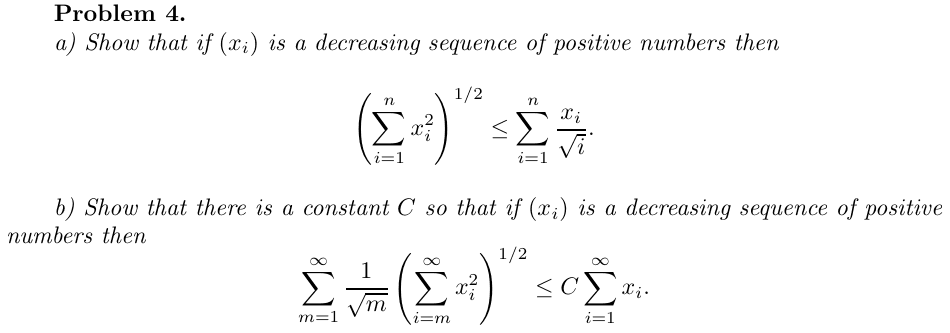
a) Show that if (xi)(x_i) is a decreasing sequence of positive numbers then

(∑i=1nxi2)1/2≤∑i=1nxii.\left(\sum_{i=1}^{n} x_i^2\right)^{1/2} \le \sum_{i=1}^{n} \frac{x_i}{\sqrt{i}}.

b) Show that there is a constant CC so that if (xi)(x_i) is a decreasing sequence of positive numbers then

∑m=1∞1m(∑i=m∞xi2)1/2≤C∑i=1∞xi.\sum_{m=1}^{\infty} \frac{1}{\sqrt{m}}\left(\sum_{i=m}^{\infty} x_i^2\right)^{1/2} \le C\sum_{i=1}^{\infty} x_i.
Original from the official PDFa) Show that if (x i ) is a decreasing sequence of positive numbers then n X x 2 i i=1 ! 1/2 n X x i √ . ≤ i i=1 b) Show that there is a constant C so that if (x i ) is a decreasing sequence of positive numbers then ! 1/2 ∞ ∞ ∞ X X X 1 2 √ ≤ C x i . x m i=m i m=1 i=1

This transcription was compared symbol by symbol with the original, but not yet by a person.

Time on this problem 0:00

Work for at least 45 minutes before opening the solution.

Official solution

Solution.

a)

(∑i=1nxii)2=∑i,jnxixjij≥∑i=1nxii∑j=1ixij≥∑i=1nxiiixii=∑i=1nxi2(\sum_{i=1}^n\frac{x_i}{\sqrt i})^2=\sum_{i,j}^n\frac{x_ix_j}{\sqrt i\sqrt j}\ge\sum_{i=1}^n\frac{x_i}{\sqrt i}\sum_{j=1}^i\frac{x_i}{\sqrt j}\ge\sum_{i=1}^n\frac{x_i}{\sqrt i}i\frac{x_i}{\sqrt i}=\sum_{i=1}^n x_i^2

b)

∑m=1∞1m(∑i=m∞xi2)1/2≤∑m=1∞1m∑i=m∞xii−m+1\sum_{m=1}^\infty\frac{1}{\sqrt m}(\sum_{i=m}^\infty x_i^2)^{1/2}\le\sum_{m=1}^\infty\frac{1}{\sqrt m}\sum_{i=m}^\infty\frac{x_i}{\sqrt{i-m+1}}

by a)

=∑i=1∞xi∑m=1i1mi−m+1=\sum_{i=1}^\infty x_i\sum_{m=1}^i\frac{1}{\sqrt m\sqrt{i-m+1}}

You can get a sharp bound on

sup⁡i∑m=1i1mi−m+1\sup_i\sum_{m=1}^i\frac{1}{\sqrt m\sqrt{i-m+1}}

by checking that it is at most

∫0i+11xi+1−xdx=π\int_0^{i+1}\frac{1}{\sqrt x\sqrt{i+1-x}}dx=\pi

Alternatively you can observe that

∑m=1i1mi+1−m=2∑m=1i/21mi+1−m≤≤21i/2∑m=1i/21m≤21i/2.2i/2=4\begin{aligned}\sum_{m=1}^i\frac{1}{\sqrt m\sqrt{i+1-m}}&=2\sum_{m=1}^{i/2}\frac{1}{\sqrt m\sqrt{i+1-m}}\le\\ &\le2\frac{1}{\sqrt{i/2}}\sum_{m=1}^{i/2}\frac{1}{\sqrt m}\le2\frac{1}{\sqrt{i/2}}.2\sqrt{i/2}=4\end{aligned}

Transcribed from the official solutions, pages 2–3. This transcription has not been checked a second time; if in doubt, look at the original.

Archive problem: the statement is the official text (transcribed, with the original above). Subject classification and difficulty were estimated automatically; hints and a worked solution are added over time.

How did it go?