IMC 2001, Day 1, Problem 1
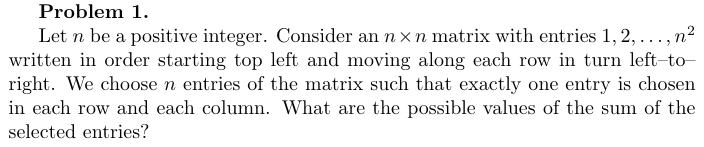
Let be a positive integer. Consider an matrix with entries written in order starting top left and moving along each row in turn left–to–right. We choose entries of the matrix such that exactly one entry is chosen in each row and each column. What are the possible values of the sum of the selected entries?
Original from the official PDF
This transcription was compared symbol by symbol with the original, but not yet by a person.
Work for at least 45 minutes before opening the solution.
Official solution
Solution. Since there are exactly rows and columns, the choice is of the form
Transcribed from the official solutions, page 1. This transcription has not been checked a second time; if in doubt, look at the original.
Archive problem: the statement is the official text (transcribed, with the original above). Subject classification and difficulty were estimated automatically; hints and a worked solution are added over time.
How did it go?
Moves you mark come back sooner in triage.