Home / IMC / 2001 / Problem 3
IMC 2001, Day 1, Problem 3
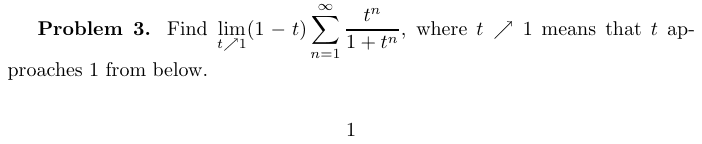
Find lim t ↗ 1 ( 1 − t ) ∑ n = 1 ∞ t n 1 + t n \displaystyle\lim_{t \nearrow 1} (1 - t)\sum_{n=1}^{\infty} \frac{t^n}{1 + t^n} t ↗ 1 lim ( 1 − t ) n = 1 ∑ ∞ 1 + t n t n t ↗ 1 t \nearrow 1 t ↗ 1 t t t 1 1 1
Original from the official PDF This transcription was compared symbol by symbol with the original, but not yet by a person.
Time on this problem
0:00
Start
Work for at least 45 minutes before opening the solution.
Official solution Solution.
lim t → 1 − 0 ( 1 − t ) ∑ n = 1 ∞ t n 1 + t n = lim t → 1 − 0 1 − t − ln t ⋅ ( − ln t ) ∑ n = 1 ∞ t n 1 + t n = \lim_{t\to1-0}(1-t)\sum_{n=1}^\infty\frac{t^n}{1+t^n}=\lim_{t\to1-0}\frac{1-t}{-\ln t}\cdot(-\ln t)\sum_{n=1}^\infty\frac{t^n}{1+t^n}= t → 1 − 0 lim ( 1 − t ) n = 1 ∑ ∞ 1 + t n t n = t → 1 − 0 lim − ln t 1 − t ⋅ ( − ln t ) n = 1 ∑ ∞ 1 + t n t n = = lim t → 1 − 0 ( − ln t ) ∑ n = 1 ∞ 1 1 + e − n ln t = lim h → + 0 h ∑ n = 1 ∞ 1 1 + e n h = ∫ 0 ∞ d x 1 + e x = ln 2. =\lim_{t\to1-0}(-\ln t)\sum_{n=1}^\infty\frac{1}{1+e^{-n\ln t}}=\lim_{h\to+0}h\sum_{n=1}^\infty\frac{1}{1+e^{nh}}=\int_0^\infty\frac{dx}{1+e^x}=\ln2. = t → 1 − 0 lim ( − ln t ) n = 1 ∑ ∞ 1 + e − n l n t 1 = h → + 0 lim h n = 1 ∑ ∞ 1 + e nh 1 = ∫ 0 ∞ 1 + e x d x = ln 2. Transcribed from the official solutions, page 2. This transcription has not been checked a second time; if in doubt, look at the original.
Archive problem: the statement is the official text (transcribed, with the original above). Subject classification and difficulty were estimated automatically; hints and a worked solution are added over time.
How did it go?
Solved it on my own
Solved it with a hint
Didn't solve it
The key idea, in your own words