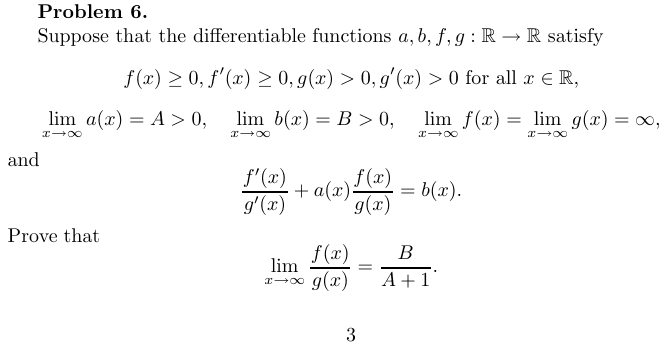
Solution. Let 0<ε<A be an arbitrary real number. If x is sufficiently large then f(x)>0, g(x)>0, ∣a(x)−A∣<ε, ∣b(x)−B∣<ε and
B−ε<b(x)=g′(x)f′(x)+a(x)g(x)f(x)<g′(x)f′(x)+(A+ε)g(x)f(x)<<A(A+ε)(A+1)⋅(A+1)⋅(g(x))A⋅g′(x)f′(x)(g(x))A+A⋅f(x)⋅(g(x))A−1⋅g′(x)==A(A+ε)(A+1)⋅((g(x))A+1)′(f(x)⋅(g(x))A)′,(1)
thus
((g(x))A+1)′(f(x)⋅(g(x))A)′>(A+ε)(A+1)A(B−ε).(2)
It can be similarly obtained that, for sufficiently large
x,
((g(x))A+1)′(f(x)⋅(g(x))A)′<(A−ε)(A+1)A(B+ε).(3)
From
ε→0, we have
x→∞lim((g(x))A+1)′(f(x)⋅(g(x))A)′=A+1B.
By l'Hospital's rule this implies
x→∞limg(x)f(x)=x→∞lim(g(x))A+1f(x)⋅(g(x))A=A+1B.
Transcribed from the official solutions, page 4. This transcription has not been checked a second time; if in doubt, look at the original.