uniolympiads Ελληνικά

IMC 2001, Day 2, Problem 2

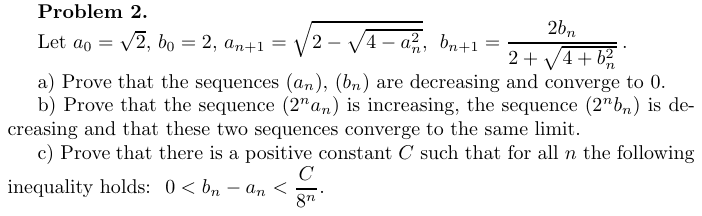
Let a0=2a_0 = \sqrt{2}, b0=2b_0 = 2, an+1=2−4−an2a_{n+1} = \sqrt{2 - \sqrt{4 - a_n^2}}, bn+1=2bn2+4+bn2b_{n+1} = \dfrac{2b_n}{2 + \sqrt{4 + b_n^2}}.

a) Prove that the sequences (an)(a_n), (bn)(b_n) are decreasing and converge to 00.

b) Prove that the sequence (2nan)(2^na_n) is increasing, the sequence (2nbn)(2^nb_n) is decreasing and that these two sequences converge to the same limit.

c) Prove that there is a positive constant CC such that for all nn the following inequality holds: 0<bn−an<C8n0 < b_n - a_n < \dfrac{C}{8^n}.

Original from the official PDFq p √ Let a 0 = 2, b 0 = 2, a n+1 = 2 − 4 − a 2 n , b n+1 = 2b n p . 2 + 4 + b 2 n a) Prove that the sequences (a n ), (b n ) are decreasing and converge to 0. b) Prove that the sequence (2 n a n ) is increasing, the sequence (2 n b n ) is de- creasing and that these two sequences converge to the same limit. c) Prove that there is a positive constant C such that for all n the following C inequality holds: 0 < b n − a n < n . 8

This transcription was compared symbol by symbol with the original, but not yet by a person.

Time on this problem 0:00

Work for at least 45 minutes before opening the solution.

Official solution

Solution. Obviously a2=2−2<2a_2=\sqrt{2-\sqrt2}<\sqrt2. Since the function f(x)=2−4−x2f(x)=\sqrt{2-\sqrt{4-x^2}} is increasing on the interval [0,2][0,2] the inequality a1>a2a_1>a_2 implies that a2>a3a_2>a_3. Simple induction ends the proof of monotonicity of (an)(a_n). In the same way we prove that (bn)(b_n) decreases (just notice that g(x)=2x2+4+x2=2/(2/x+1+4/x2))\left(\text{just notice that }g(x)=\dfrac{2x}{2+\sqrt{4+x^2}}=2/\Bigl(2/x+\sqrt{1+4/x^2}\Bigr)\right). It is a matter of simple manipulation to prove that 2f(x)>x2f(x)>x for all x∈(0,2)x\in(0,2), this implies that the sequence (2nan)(2^na_n) is strictly increasing. The inequality 2g(x)<x2g(x)<x for x∈(0,2)x\in(0,2) implies that the sequence (2nbn)(2^nb_n) strictly decreases. By an easy induction one can show that an2=4bn24+bn2a_n^2=\frac{4b_n^2}{4+b_n^2} for positive integers nn. Since the limit of the decreasing sequence (2nbn)(2^nb_n) of positive numbers is finite we have

lim⁡4nan2=lim⁡4⋅4nbn24+bn2=lim⁡4nbn2 .\lim4^na_n^2=\lim\frac{4\cdot4^nb_n^2}{4+b_n^2}=\lim4^nb_n^2\,.
We know already that the limits lim⁡2nan\lim2^na_n and lim⁡2nbn\lim2^nb_n are equal. The first of the two is positive because the sequence (2nan)(2^na_n) is strictly increasing. The existence of a number CC follows easily from the equalities
2nbn−2nan=(4nbn2−4n+1bn24+bn2)/(2nbn+2nan)=(2nbn)44+bn2⋅14n⋅12n(bn+an)2^nb_n-2^na_n=\Bigl(4^nb_n^2-\frac{4^{n+1}b_n^2}{4+b_n^2}\Bigr)/\bigl(2^nb_n+2^na_n\bigr)=\frac{(2^nb_n)^4}{4+b_n^2}\cdot\frac{1}{4^n}\cdot\frac{1}{2^n(b_n+a_n)}
and from the existence of positive limits lim⁡2nbn\lim2^nb_n and lim⁡2nan\lim2^na_n.

Remark. The last problem may be solved in a much simpler way by someone who is able to make use of sine and cosine. It is enough to notice that an=2sin⁡π2n+1a_n=2\sin\dfrac{\pi}{2^{n+1}} and bn=2tan⁡π2n+1b_n=2\tan\dfrac{\pi}{2^{n+1}}.

Transcribed from the official solutions, pages 1–2. This transcription has not been checked a second time; if in doubt, look at the original.

Archive problem: the statement is the official text (transcribed, with the original above). Subject classification and difficulty were estimated automatically; hints and a worked solution are added over time.

How did it go?