uniolympiads Ελληνικά

IMC 2001, Day 2, Problem 6

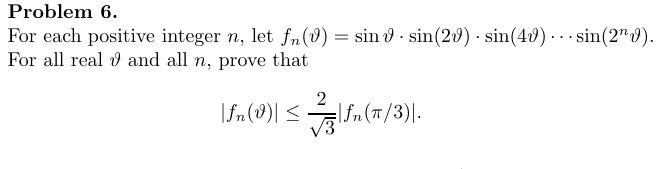
For each positive integer nn, let fn(ϑ)=sin⁡ϑ⋅sin⁡(2ϑ)⋅sin⁡(4ϑ)⋯sin⁡(2nϑ)f_n(\vartheta) = \sin\vartheta \cdot \sin(2\vartheta) \cdot \sin(4\vartheta) \cdots \sin(2^n\vartheta). For all real ϑ\vartheta and all nn, prove that

∣fn(ϑ)∣≤23∣fn(π/3)∣.|f_n(\vartheta)| \le \frac{2}{\sqrt{3}}|f_n(\pi/3)|.
Original from the official PDFFor each positive integer n, let f n (ϑ) = sin ϑ · sin(2ϑ) · sin(4ϑ) · · · sin(2 n ϑ). For all real ϑ and all n, prove that 2 |f n (ϑ)| ≤ √ |f n (π/3)|. 3

This transcription was compared symbol by symbol with the original, but not yet by a person.

Time on this problem 0:00

Work for at least 45 minutes before opening the solution.

Official solution

Solution. We prove that g(ϑ)=∣sin⁡ϑ∣∣sin⁡(2ϑ)∣1/2g(\vartheta)=|\sin\vartheta||\sin(2\vartheta)|^{1/2} attains its maximum value (3/2)3/2(\sqrt3/2)^{3/2} at points 2kπ/32^k\pi/3 (where kk is a positive integer). This can be seen by using derivatives or a classical bound like

∣g(ϑ)∣=∣sin⁡ϑ∣∣sin⁡(2ϑ)∣1/2=234(∣sin⁡ϑ∣⋅∣sin⁡ϑ∣⋅∣sin⁡ϑ∣⋅∣3cos⁡ϑ∣4)2≤234⋅3sin⁡2ϑ+3cos⁡2ϑ4=(32)3/2.\begin{aligned}|g(\vartheta)|=|\sin\vartheta||\sin(2\vartheta)|^{1/2}&=\frac{\sqrt2}{\sqrt[4]3}\left(\sqrt[4]{|\sin\vartheta|\cdot|\sin\vartheta|\cdot|\sin\vartheta|\cdot|\sqrt3\cos\vartheta|}\right)^2\\&\le\frac{\sqrt2}{\sqrt[4]3}\cdot\frac{3\sin^2\vartheta+3\cos^2\vartheta}{4}=\left(\frac{\sqrt3}{2}\right)^{3/2}.\end{aligned}
Hence
∣fn(ϑ)fn(π/3)∣=∣g(ϑ)⋅g(2ϑ)1/2⋅g(4ϑ)3/4⋯g(2n−1ϑ)Eg(π/3)⋅g(2π/3)1/2⋅g(4π/3)3/4⋯g(2n−1π/3)E∣⋅∣sin⁡(2nϑ)sin⁡(2nπ/3)∣1−E/2≤∣sin⁡(2nϑ)sin⁡(2nπ/3)∣1−E/2≤(13/2)1−E/2≤23.\begin{aligned}\left|\frac{f_n(\vartheta)}{f_n(\pi/3)}\right|&=\left|\frac{g(\vartheta)\cdot g(2\vartheta)^{1/2}\cdot g(4\vartheta)^{3/4}\cdots g(2^{n-1}\vartheta)^E}{g(\pi/3)\cdot g(2\pi/3)^{1/2}\cdot g(4\pi/3)^{3/4}\cdots g(2^{n-1}\pi/3)^E}\right|\cdot\left|\frac{\sin(2^n\vartheta)}{\sin(2^n\pi/3)}\right|^{1-E/2}\\&\le\left|\frac{\sin(2^n\vartheta)}{\sin(2^n\pi/3)}\right|^{1-E/2}\le\left(\frac{1}{\sqrt3/2}\right)^{1-E/2}\le\frac{2}{\sqrt3}.\end{aligned}
where E=23(1−(−1/2)n)E=\frac23(1-(-1/2)^n). This is exactly the bound we had to prove.

Transcribed from the official solutions, page 5. This transcription has not been checked a second time; if in doubt, look at the original.

Archive problem: the statement is the official text (transcribed, with the original above). Subject classification and difficulty were estimated automatically; hints and a worked solution are added over time.
How did it go?