uniolympiads Ελληνικά

IMC 2010, Day 2, Problem 5

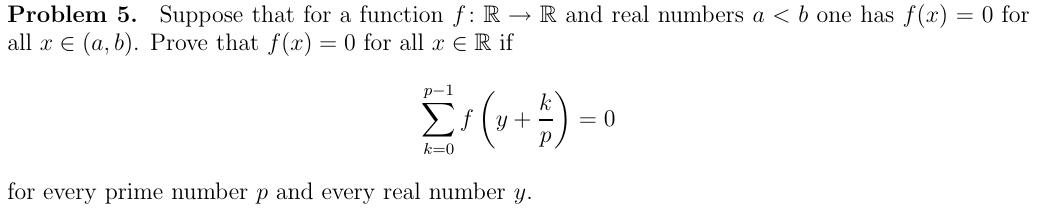
Suppose that for a function f ⁣:R→Rf\colon \mathbb{R} \to \mathbb{R} and real numbers a<ba < b one has f(x)=0f(x) = 0 for all x∈(a,b)x \in (a, b). Prove that f(x)=0f(x) = 0 for all x∈Rx \in \mathbb{R} if

∑k=0p−1f(y+kp)=0\sum_{k=0}^{p-1} f\left(y + \frac{k}{p}\right) = 0

for every prime number pp and every real number yy.

Original from the official PDFSuppose that for a function f : R → R and real numbers a < b one has f (x) = 0 for all x ∈ (a, b). Prove that f (x) = 0 for all x ∈ R if p−1 X k =0 f y + p k=0 for every prime number p and every real number y.

This transcription was compared symbol by symbol with the original, but not yet by a person.

Time on this problem 0:00

Work for at least 45 minutes before opening the solution.

Official solution

Solution. Let N>1N>1 be some integer to be defined later, and consider set of real polynomials

JN={ c0+c1x+…+cnxn∈R[x]   |   ∀x∈R  ∑k=0nckf(x+kN)=0 }.\mathcal{J}_N=\left\{\ c_0+c_1x+\ldots+c_nx^n\in\mathbb{R}[x]\ \;\middle|\;\ \forall x\in\mathbb{R}\ \ \sum_{k=0}^n c_kf\Big(x+\frac{k}{N}\Big)=0\ \right\}.
Notice that 0∈JN0\in\mathcal{J}_N, any linear combinations of any elements in JN\mathcal{J}_N is in JN\mathcal{J}_N, and for every P(x)∈JNP(x)\in\mathcal{J}_N we have xP(x)∈JNxP(x)\in\mathcal{J}_N. Hence, JN\mathcal{J}_N is an ideal of the ring R[x]\mathbb{R}[x].

By the problem's conditions, for every prime divisors of NN we have xN−1xN/p−1∈JN\dfrac{x^N-1}{x^{N/p}-1}\in\mathcal{J}_N. Since R[x]\mathbb{R}[x] is a principal ideal domain (due to the Euclidean algorithm), the greatest common divisor of these polynomials is an element of JN\mathcal{J}_N. The complex roots of the polynomial xN−1xN/p−1\dfrac{x^N-1}{x^{N/p}-1} are those NNth roots of unity whose order does not divide N/pN/p. The roots of the greatest common divisor is the intersection of such sets; it can be seen that the intersection consist of the primitive NNth roots of unity. Therefore,

gcd⁡{ xN−1xN/p−1   |   p∣N }=ΦN(x)\gcd\left\{\ \frac{x^N-1}{x^{N/p}-1}\ \;\middle|\;\ p\big|N\ \right\}=\Phi_N(x)
is the NNth cyclotomic polynomial. So ΦN∈JN\Phi_N\in\mathcal{J}_N, which polynomial has degree φ(N)\varphi(N).

Now choose NN in such a way that φ(N)N<b−a\dfrac{\varphi(N)}{N}<b-a. It is well-known that lim inf⁡N→∞φ(N)N=0\liminf\limits_{N\to\infty}\dfrac{\varphi(N)}{N}=0, so there exists such a value for NN. Let ΦN(x)=a0+a1x+…+aφ(N)xφ(N)\Phi_N(x)=a_0+a_1x+\ldots+a_{\varphi(N)}x^{\varphi(N)} where aφ(N)=1a_{\varphi(N)}=1 and ∣a0∣=1|a_0|=1. Then, by the definition of JN\mathcal{J}_N, we have ∑k=0φ(N)akf(x+kN)=0\sum\limits_{k=0}^{\varphi(N)}a_kf\big(x+\frac{k}{N}\big)=0 for all x∈Rx\in\mathbb{R}.

If x∈[b,b+1N)x\in[b,b+\frac1N), then

f(x)=−∑k=0φ(N)−1akf(x−φ(N)−kN).f(x)=-\sum_{k=0}^{\varphi(N)-1}a_kf\Big(x-\tfrac{\varphi(N)-k}{N}\Big).
On the right-hand side, all numbers x−φ(N)−kNx-\frac{\varphi(N)-k}{N} lie in (a,b)(a,b). Therefore the right-hand side is zero, and f(x)=0f(x)=0 for all x∈[b,b+1N)x\in[b,b+\frac1N). It can be obtained similarly that f(x)=0f(x)=0 for all x∈(a−1N,a]x\in(a-\frac1N,a] as well. Hence, f=0f=0 in the interval (a−1N,b+1N)(a-\frac1N,b+\frac1N). Continuing in this fashion we see that ff must vanish everywhere.

Transcribed from the official solutions, page 4. This transcription has not been checked a second time; if in doubt, look at the original.

Archive problem: the statement is the official text (transcribed, with the original above). Subject classification and difficulty were estimated automatically; hints and a worked solution are added over time.

How did it go?