uniolympiads Ελληνικά

IMC 2016, Day 1, Problem 3

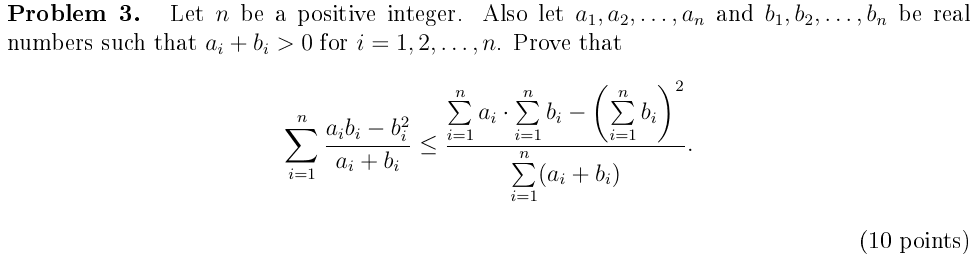
Let nn be a positive integer. Also let a1,a2,…,ana_1, a_2, \dots, a_n and b1,b2,…,bnb_1, b_2, \dots, b_n be real numbers such that ai+bi>0a_i + b_i > 0 for i=1,2,…,ni = 1, 2, \dots, n. Prove that

∑i=1naibi−bi2ai+bi≤∑i=1nai⋅∑i=1nbi−(∑i=1nbi)2∑i=1n(ai+bi).\sum_{i=1}^{n} \frac{a_ib_i - b_i^2}{a_i + b_i} \le \frac{\sum_{i=1}^{n} a_i \cdot \sum_{i=1}^{n} b_i - \left(\sum_{i=1}^{n} b_i\right)^2}{\sum_{i=1}^{n} (a_i + b_i)}.
Original from the official PDFLet n be a positive integer. Also let a 1 , a 2 , . . . , a n and b 1 , b 2 , . . . , b n be real numbers such that a i + b i > 0 for i = 1, 2, . . . , n . Prove that Problem 3. n X a i b i − b 2 i i=1 a i + b i n P ≤ i=1 a i · n P n 2 P b i − b i i=1 i=1 n P . (a i + b i ) i=1

This transcription was compared symbol by symbol with the original, but not yet by a person.

Time on this problem 0:00

Work for at least 45 minutes before opening the solution.

Official solution

(Proposed by Daniel Strzelecki, Nicolaus Copernicus University in TorÞn, Poland)

Solution. By applying the identity

XY−Y2X+Y=Y−2Y2X+Y\frac{XY - Y^2}{X+Y} = Y - \frac{2Y^2}{X+Y}
with X=aiX = a_i and Y=biY = b_i to the terms in the LHS and X=∑i=1naiX = \sum\limits_{i=1}^n a_i and Y=∑i=1nbiY = \sum\limits_{i=1}^n b_i to the RHS,
LHS=∑i=1naibi−bi2ai+bi=∑i=1n(bi−2bi2ai+bi)=∑i=1nbi−2∑i=1nbi2ai+bi,RHS=∑i=1nai⋅∑i=1nbi−(∑i=1nbi)2∑i=1nai+∑i=1nbi=∑i=1nbi−2(∑i=1nbi)2∑i=1n(ai+bi).\begin{aligned} LHS &= \sum_{i=1}^n \frac{a_ib_i - b_i^2}{a_i + b_i} = \sum_{i=1}^n \left( b_i - \frac{2b_i^2}{a_i+b_i} \right) = \sum_{i=1}^n b_i - 2\sum_{i=1}^n \frac{b_i^2}{a_i+b_i}, \\ RHS &= \frac{\sum\limits_{i=1}^n a_i \cdot \sum\limits_{i=1}^n b_i - \left( \sum\limits_{i=1}^n b_i \right)^2}{\sum\limits_{i=1}^n a_i + \sum\limits_{i=1}^n b_i} = \sum_{i=1}^n b_i - 2\frac{\left( \sum\limits_{i=1}^n b_i \right)^2}{\sum\limits_{i=1}^n (a_i + b_i)}. \end{aligned}
Therefore, the statement is equivalent with
∑i=1nbi2ai+bi≥(∑i=1nbi)2∑i=1n(ai+bi),\sum_{i=1}^n \frac{b_i^2}{a_i + b_i} \ge \frac{\left( \sum\limits_{i=1}^n b_i \right)^2}{\sum\limits_{i=1}^n (a_i + b_i)},
which is the same as the well-known variant of the Cauchy-Schwarz inequality,
∑i=1nXi2Yi≥(X1+…+Xn)2Y1+…+Yn(Y1,…,Yn>0)\sum_{i=1}^n \frac{X_i^2}{Y_i} \ge \frac{(X_1 + \ldots + X_n)^2}{Y_1 + \ldots + Y_n} \quad (Y_1,\ldots,Y_n > 0)
with Xi=biX_i = b_i and Yi=ai+biY_i = a_i + b_i.

Transcribed from the official solutions, pages 2–3. This transcription has not been checked a second time; if in doubt, look at the original.

Archive problem: the statement is the official text (transcribed, with the original above). Subject classification and difficulty were estimated automatically; hints and a worked solution are added over time.

How did it go?