IMC 2017, Day 2, Problem 10
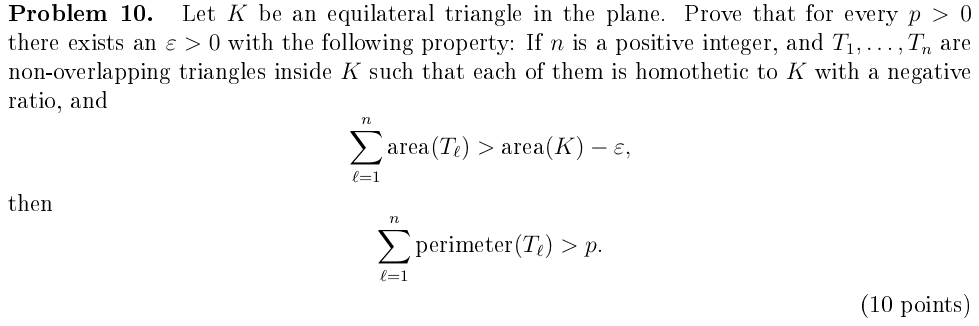
Let be an equilateral triangle in the plane. Prove that for every there exists an with the following property: If is a positive integer, and are non-overlapping triangles inside such that each of them is homothetic to with a negative ratio, and
then
Original from the official PDF
This transcription was compared symbol by symbol with the original, but not yet by a person.
Work for at least 45 minutes before opening the solution.
Official solution
(Proposed by Fedor Malyshev, Steklov Math. Inst. and Ilya Bogdanov, MIPT, Moscow)
Solution. For an arbitrary we will establish a lower bound for the sum of perimeters that would tend to as ; this solves the problem.
Rotate and scale the picture so that one of the sides of is the segment from to , and stretch the picture horizontally in such a way that the projection of to the axis is . Evidently, we may work with the lengths of the projections to the or axis instead of the perimeters and consider their sum, that is why we may make any affine transformation.
Let be the length of intersection of the straight line with and put . Then is piece-wise increasing with possible downward gaps, , and
Let be the values of the gaps of . Every gap is a sum of side-lengths of some of and every contributes to one of , we therefore estimate the sum of the gaps of .
In the points of differentiability of we have ; this follows from after summation. Indeed, if is zero this inequality holds trivially, and if not then and the inequality reads , which is clear from the definition.
Choose an integer (considering sufficiently small). Then for all in the section of by the strip the area, covered by the small triangles is no smaller than . Thus
Transcribed from the official solutions, page 5. This transcription has not been checked a second time; if in doubt, look at the original.
Archive problem: the statement is the official text (transcribed, with the original above). Subject classification and difficulty were estimated automatically; hints and a worked solution are added over time.
How did it go?
Moves you mark come back sooner in triage.