uniolympiads Ελληνικά

IMC 2018, Day 1, Problem 1

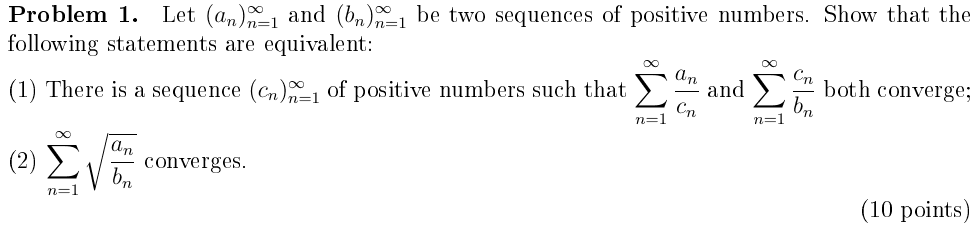
Let (an)n=1∞(a_n)_{n=1}^{\infty} and (bn)n=1∞(b_n)_{n=1}^{\infty} be two sequences of positive numbers. Show that the following statements are equivalent:

(1) There is a sequence (cn)n=1∞(c_n)_{n=1}^{\infty} of positive numbers such that ∑n=1∞ancn\sum_{n=1}^{\infty} \frac{a_n}{c_n} and ∑n=1∞cnbn\sum_{n=1}^{\infty} \frac{c_n}{b_n} both converge;

(2) ∑n=1∞anbn\sum_{n=1}^{\infty} \sqrt{\frac{a_n}{b_n}} converges.

Original from the official PDF∞ Let (a n ) ∞ n=1 and (b n ) n=1 be two sequences of positive numbers. Show that the following statements are equivalent: Problem 1. (1) There is a sequence (2) ∞ r X a n n=1 b n (c n ) ∞ n=1 of positive numbers such that ∞ X a n c n=1 n and ∞ X c n b n=1 n both converge; converges.

This transcription was compared symbol by symbol with the original, but not yet by a person.

Time on this problem 0:00

Work for at least 45 minutes before opening the solution.

Official solution

(Proposed by Tomáš Bárta, Charles University, Prague)

Solution. Note that the sum of a series with positive terms can be either finite or +∞+\infty, so for such a series, "converges" is equivalent to "is finite".

Proof for (1)  ⟹  (2)(1) \implies (2): By the AM-GM inequality,

anbn=ancn⋅cnbn≤12(ancn+cnbn),\sqrt{\frac{a_n}{b_n}} = \sqrt{\frac{a_n}{c_n}\cdot\frac{c_n}{b_n}} \le \frac{1}{2}\left(\frac{a_n}{c_n} + \frac{c_n}{b_n}\right),
so
∑n=1∞anbn≤12∑n=1∞ancn+12∑n=1∞cnbn<+∞.\sum_{n=1}^{\infty}\sqrt{\frac{a_n}{b_n}} \le \frac{1}{2}\sum_{n=1}^{\infty}\frac{a_n}{c_n} + \frac{1}{2}\sum_{n=1}^{\infty}\frac{c_n}{b_n} < +\infty.
Hence, ∑n=1∞anbn\displaystyle\sum_{n=1}^{\infty}\sqrt{\frac{a_n}{b_n}} is finite and therefore convergent.

Proof for (2)  ⟹  (1)(2) \implies (1): Choose cn=anbnc_n = \sqrt{a_nb_n}. Then

ancn=cnbn=anbn.\frac{a_n}{c_n} = \frac{c_n}{b_n} = \sqrt{\frac{a_n}{b_n}}.
By the condition ∑n=1∞anbn\displaystyle\sum_{n=1}^{\infty}\sqrt{\frac{a_n}{b_n}} converges, therefore ∑n=1∞ancn\displaystyle\sum_{n=1}^{\infty}\frac{a_n}{c_n} and ∑n=1∞cnbn\displaystyle\sum_{n=1}^{\infty}\frac{c_n}{b_n} converge, too.

Transcribed from the official solutions, page 1. This transcription has not been checked a second time; if in doubt, look at the original.

Archive problem: the statement is the official text (transcribed, with the original above). Subject classification and difficulty were estimated automatically; hints and a worked solution are added over time.

How did it go?