IMC 2018, Day 1, Problem 3
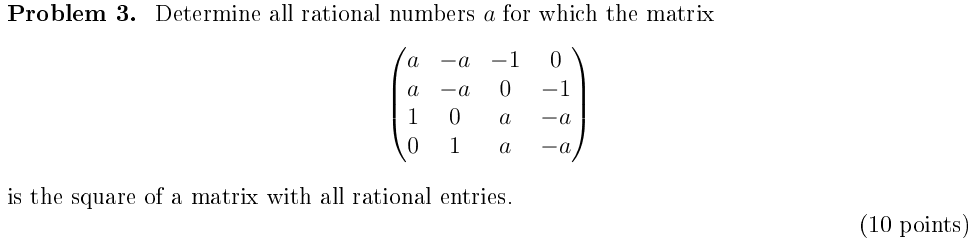
Determine all rational numbers for which the matrix
is the square of a matrix with all rational entries.
Original from the official PDF
This transcription was compared symbol by symbol with the original, but not yet by a person.
Work for at least 45 minutes before opening the solution.
Official solution
(Proposed by Daniël Kroes, University of California, San Diego)
Solution. We will show that the only such number is .
Let and suppose that . It is easy to compute the characteristic polynomial of , which is
Let be the minimal polynomial of . The minimal polynomial divides all polynomials that vanish at ; in particular must be a divisor of the polynomial . The polynomial has rational coefficients and degree at most . On the other hand, the polynomial , being the 8th cyclotomic polynomial, is irreducible in . Hence the only possibility for is . Therefore,
Since we have
In case we have
Transcribed from the official solutions, page 2. This transcription has not been checked a second time; if in doubt, look at the original.
Archive problem: the statement is the official text (transcribed, with the original above). Subject classification and difficulty were estimated automatically; hints and a worked solution are added over time.
How did it go?
Moves you mark come back sooner in triage.