uniolympiads Ελληνικά

IMC 2019, Day 1, Problem 2

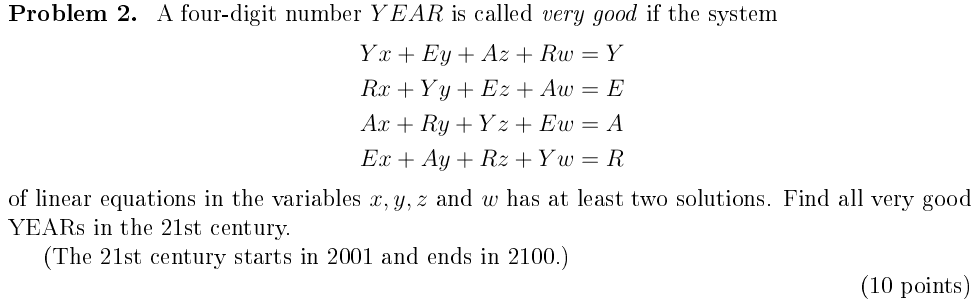
A four-digit number YEARYEAR is called very good if the system

Yx+Ey+Az+Rw=YRx+Yy+Ez+Aw=EAx+Ry+Yz+Ew=AEx+Ay+Rz+Yw=R\begin{aligned} Yx + Ey + Az + Rw &= Y \\ Rx + Yy + Ez + Aw &= E \\ Ax + Ry + Yz + Ew &= A \\ Ex + Ay + Rz + Yw &= R \end{aligned}

of linear equations in the variables x,y,zx, y, z and ww has at least two solutions. Find all very good YEARs in the 21st century. (The 21st century starts in 2001 and ends in 2100.)

Original from the official PDFA four-digit number Y EAR is called very good if the system Y x + Ey + Az + Rw = Y Rx + Y y + Ez + Aw = E Ax + Ry + Y z + Ew = A Ex + Ay + Rz + Y w = R of linear equations in the variables x, y, z and w has at least two solutions. Find all very good YEARs in the 21st century. (The 21st century starts in 2001 and ends in 2100.)

This transcription was compared symbol by symbol with the original, but not yet by a person.

Time on this problem 0:00

Work for at least 45 minutes before opening the solution.

Official solution

Proposed by Tomáš Bárta, Charles University, Prague

Hint: If the solution of the system is not unique then det⁡(YEARRYEAARYEEARY)=0\det\begin{pmatrix} Y & E & A & R\\ R & Y & E & A\\ A & R & Y & E\\ E & A & R & Y\end{pmatrix} = 0.

Solution. Let us apply row transformations to the augmented matrix of the system to find its rank. First we add the second, third and fourth row to the first one and divide by Y+E+A+RY+E+A+R to get

(11111RYEAEARYEAEARYR)∼(111110Y−RE−RA−RE−R0R−AY−AE−A00A−ER−EY−ER−E)∼(111110Y−RE−RA−RE−R0R−AY−AE−A00A−E+Y−R0Y−E+A−R0)\begin{aligned} \begin{pmatrix} 1 & 1 & 1 & 1 & 1\\ R & Y & E & A & E\\ A & R & Y & E & A\\ E & A & R & Y & R\end{pmatrix} &\sim \begin{pmatrix} 1 & 1 & 1 & 1 & 1\\ 0 & Y-R & E-R & A-R & E-R\\ 0 & R-A & Y-A & E-A & 0\\ 0 & A-E & R-E & Y-E & R-E\end{pmatrix} \\ &\sim \begin{pmatrix} 1 & 1 & 1 & 1 & 1\\ 0 & Y-R & E-R & A-R & E-R\\ 0 & R-A & Y-A & E-A & 0\\ 0 & A-E+Y-R & 0 & Y-E+A-R & 0\end{pmatrix} \end{aligned}

Let us first omit the last column and look at the remaining 4×44\times 4 matrix. If E≠RE \ne R, the first and second rows are linearly independent, so the rank of the matrix is at least 22 and rank of the augmented 4×54\times 5 matrix cannot be bigger than rank of the 4×44\times 4 matrix due to the zeros in the last column.

IF E=RE = R, then we have three zeros in the last column, so rank of the 4×54\times 5 matrix cannot be bigger than rank of the 4×44\times 4 matrix. So, the original system has always at least one solution.

It follows that the system has more than one solution if and only if the 4×44\times 4 matrix (with the last column omitted) is singular. Let us first assume that E≠RE \ne R. We apply one more transform to get

∼(11110Y−RE−RA−R0(R−A)(E−R)−(Y−R)(Y−A)0(E−A)(E−R)−(A−R)(Y−A)0A−E+Y−R0Y−E+A−R)\sim \begin{pmatrix} 1 & 1 & 1 & 1\\ 0 & Y-R & E-R & A-R\\ 0 & (R-A)(E-R)-(Y-R)(Y-A) & 0 & (E-A)(E-R)-(A-R)(Y-A)\\ 0 & A-E+Y-R & 0 & Y-E+A-R\end{pmatrix}

Obviously, this matrix is singular if and only if A−E+Y−R=0A-E+Y-R = 0 or the two expressions in the third row are equal, i.e.

RE−R2−AE+AR−Y2+RY+AY−AR=E2−AE−ER+AR−AY+RY+A2−ARRE - R^2 - AE + AR - Y^2 + RY + AY - AR = E^2 - AE - ER + AR - AY + RY + A^2 - AR
0=(E−R)2+(A−Y)2,0 = (E-R)^2 + (A-Y)^2,
but this is impossible if E≠RE \ne R. If E=RE = R, we have
∼(11110Y−R0A−R0R−AY−AR−A0A+Y−2R0Y+A−2R)∼(11110Y−R0A−R0R−AY−AR−A0A−R0Y−R).\sim \begin{pmatrix} 1 & 1 & 1 & 1\\ 0 & Y-R & 0 & A-R\\ 0 & R-A & Y-A & R-A\\ 0 & A+Y-2R & 0 & Y+A-2R\end{pmatrix} \sim \begin{pmatrix} 1 & 1 & 1 & 1\\ 0 & Y-R & 0 & A-R\\ 0 & R-A & Y-A & R-A\\ 0 & A-R & 0 & Y-R\end{pmatrix}.

If A=YA = Y, this matrix is singular. If A≠YA \ne Y, the matrix is regular if and only if (Y−R)2≠(A−R)2(Y-R)^2 \ne (A-R)^2 and since Y≠AY \ne A, it means that Y−R≠−(A−R)Y-R \ne -(A-R), i.e. Y+A≠2RY + A \ne 2R. We conclude that YEAR is very good if and only if

  1. E≠RE \ne R and A+Y=E+RA+Y = E+R, or
  2. E=RE = R and Y=AY = A, or
  3. E=RE = R, A≠YA \ne Y and Y+A=2RY+A = 2R.

We can see that if Y=2Y = 2, E=0E = 0, then the very good years satisfying 1 are A+2=R≠0A+2 = R \ne 0, i.e. 2002, 2013, 2024, 2035, 2046, 2057, 2068, 2079, condition 2 is satisfied for 2020 and condition 3 never satisfied.

Transcribed from the official solutions, pages 1–3. This transcription has not been checked a second time; if in doubt, look at the original.

Archive problem: the statement is the official text (transcribed, with the original above). Subject classification and difficulty were estimated automatically; hints and a worked solution are added over time.

How did it go?