IMC 2020, Day 2, Problem 7
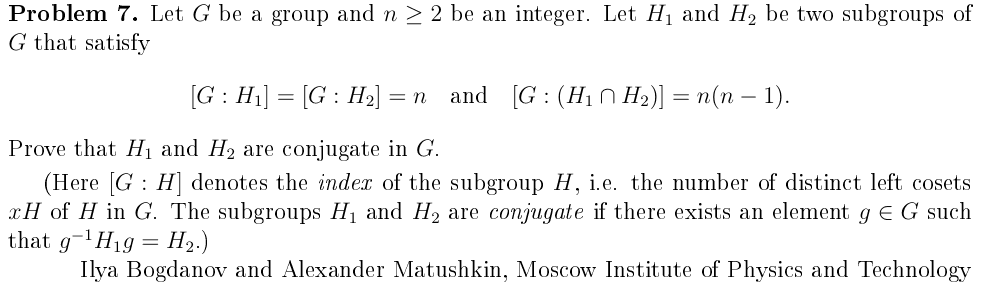
Let be a group and be an integer. Let and be two subgroups of that satisfy
Prove that and are conjugate in .
(Here denotes the index of the subgroup , i.e. the number of distinct left cosets of in . The subgroups and are conjugate if there exists an element such that .)
Ilya Bogdanov and Alexander Matushkin, Moscow Institute of Physics and Technology
Original from the official PDF
This transcription was compared symbol by symbol with the original, but not yet by a person.
Work for at least 45 minutes before opening the solution.
Official solution
Ilya Bogdanov and Alexander Matushkin, Moscow Institute of Physics and Technology
Solution 1. Denote . Since
The last equality holds because , so . The last expression is a disjoint union since
Thus, is a disjoint union of left cosets with respect to ; hence is the remaining such left coset. Similarly, is a right coset with respect to . Therefore, for each we have , which yields .
Solution 2. Put and , those are -element sets acted on by from the left. Let act on from the left coordinate-wise, consider this product as a table, with rows being copies of and columns being copies of .
The stabilizer of a point in is . By the orbit-stabilizer theorem, we obtain that the orbit of has size .
If contains a whole column then there is a subgroup of that stabilizes and acts transitively on . If we conjugate to a group , then its action remains transitive on , so by conjugation we obtain columns of the table. Since acts transitively on , we cover all the columns. It follows that , so
Hence every column of has an element not from . The same holds for the rows of . There are elements not from in total and they induce a bijection between and which allows us to identify .
After this identification, every element from the diagonal of (i.e. from ) is moved to a diagonal element by any , because . In this formula the action of in the left hand side and the action of in the right hand side are the actions of on and respectively.
Therefore our bijection between and is an isomorphism of sets with a left action of . Since and are stabilizers of the points in the same transitive action of , we conclude that they are conjugate.
Remark. The situation in the problem is possible for every : let and let an be the stabilizer subgroups of two elements.
Transcribed from the official solutions, pages 3–5. This transcription has not been checked a second time; if in doubt, look at the original.
Archive problem: the statement is the official text (transcribed, with the original above). Subject classification and difficulty were estimated automatically; hints and a worked solution are added over time.
How did it go?
Moves you mark come back sooner in triage.