IMC 2021, Day 1, Problem 2
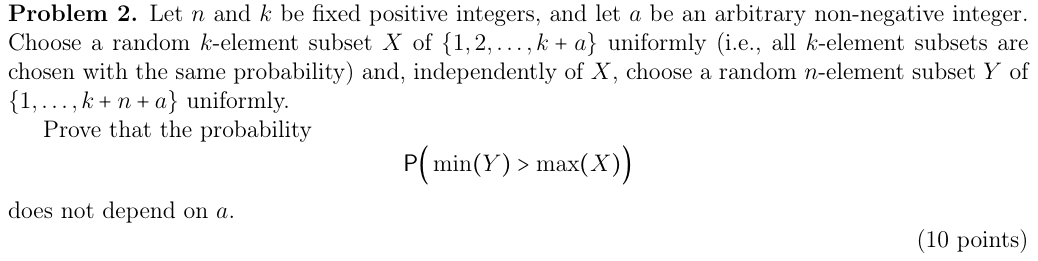
Let and be fixed positive integers, and let be an arbitrary non-negative integer. Choose a random -element subset of uniformly (i.e., all -element subsets are chosen with the same probability) and, independently of , choose a random -element subset of uniformly.
Prove that the probability
does not depend on .
Original from the official PDF
This transcription was compared symbol by symbol with the original, but not yet by a person.
Work for at least 45 minutes before opening the solution.
Official solution
(proposed by Fedor Petrov, St. Petersburg State University)
Hint: The sets and with are uniquely determined by .
Solution 1. The number of choices for is .
The number of such choices with is equal to since this is the number of choices for the -element set and this union together with the condition determines and uniquely (note in particular that no elements of will be larger than ). Hence the probability is
Since the right hand side is independent of , the claim follows.
Solution 2. Let be the increasing bijection from to . Note that if and only if .
Note that
If an -subset is fixed, the conditional probability that always equals . Therefore the total probability also equals .
Transcribed from the official solutions, pages 2–3. This transcription has not been checked a second time; if in doubt, look at the original.
Archive problem: the statement is the official text (transcribed, with the original above). Subject classification and difficulty were estimated automatically; hints and a worked solution are added over time.
How did it go?
Moves you mark come back sooner in triage.