uniolympiads Ελληνικά

IMC 2024, Day 1, Problem 2

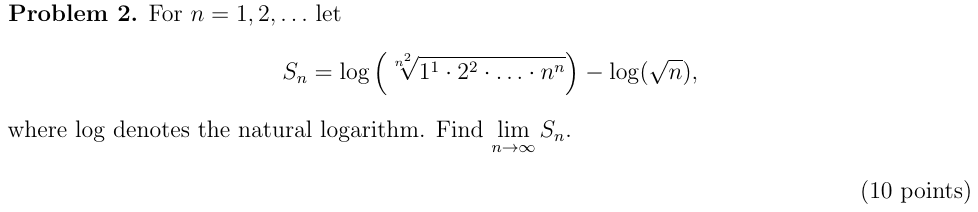
For n=1,2,…n = 1, 2, \dots let

Sn=log⁡(11⋅22⋅…⋅nnn2)−log⁡(n),S_n = \log\left(\sqrt[n^2]{1^1 \cdot 2^2 \cdot \ldots \cdot n^n}\right) - \log(\sqrt{n}),

where log⁡\log denotes the natural logarithm. Find lim⁡n→∞Sn\lim_{n \to \infty} S_n.

Original from the official PDFFor n = 1, 2, . . . let S n = log √ 2 n √ 1 1 · 2 2 · . . . · n n − log( n), where log denotes the natural logarithm. Find lim S n . n→∞

This transcription was compared symbol by symbol with the original, but not yet by a person.

Time on this problem 0:00

Work for at least 45 minutes before opening the solution.

Official solution

(proposed by Sergey Chernov, Belarusian State University, Minsk)

Hint: SnS_n is (close to) a Riemann sum of a certain integral.

Solution. Transform SnS_n as

Sn=1n2∑k=1nklog⁡k−12log⁡n=1n∑k=1n(kn(log⁡kn+log⁡n))−12log⁡n=1n∑k=1nknlog⁡kn+log⁡nn2∑k=1nk−12log⁡n=1n∑k=1nknlog⁡kn+log⁡n2n.\begin{aligned} S_n &= \frac{1}{n^2}\sum_{k=1}^{n} k\log k - \frac{1}{2}\log n \\ &= \frac{1}{n}\sum_{k=1}^{n}\bigg(\frac{k}{n}\Big(\log\frac{k}{n} + \log n\Big)\bigg) - \frac{1}{2}\log n \\ &= \frac{1}{n}\sum_{k=1}^{n}\frac{k}{n}\log\frac{k}{n} + \frac{\log n}{n^2}\sum_{k=1}^{n} k - \frac{1}{2}\log n \\ &= \frac{1}{n}\sum_{k=1}^{n}\frac{k}{n}\log\frac{k}{n} + \frac{\log n}{2n}. \end{aligned}

Here the last term log⁡n2n\dfrac{\log n}{2n} converges to 00. The sum 1n∑k=1nknlog⁡kn\dfrac{1}{n}\sum\limits_{k=1}^{n}\dfrac{k}{n}\log\dfrac{k}{n} is a Riemann sum for the integrable function f(x)=xlog⁡xf(x) = x\log x on the segment [0,1][0, 1] with the uniform grid {1n,2n,…,n−1n,1}\left\{\dfrac{1}{n}, \dfrac{2}{n}, \dots, \dfrac{n-1}{n}, 1\right\}. Therefore

lim⁡1n∑k=1nknlog⁡kn=lim⁡1n∑k=1nf(kn)=∫01xlog⁡x dx=[x22log⁡x−x24]01=−14.\lim\frac{1}{n}\sum_{k=1}^{n}\frac{k}{n}\log\frac{k}{n} = \lim\frac{1}{n}\sum_{k=1}^{n} f\Big(\frac{k}{n}\Big) = \int_0^1 x\log x\,\mathrm{d}x = \left[\frac{x^2}{2}\log x - \frac{x^2}{4}\right]_0^1 = -\frac{1}{4}.

Hence, lim⁡Sn\lim S_n exists, and lim⁡Sn=−14\lim S_n = -\dfrac{1}{4}.

Transcribed from the official solutions, pages 2–3. This transcription has not been checked a second time; if in doubt, look at the original.

Archive problem: the statement is the official text (transcribed, with the original above). Subject classification and difficulty were estimated automatically; hints and a worked solution are added over time.

How did it go?