IMC 2024, Day 1, Problem 4
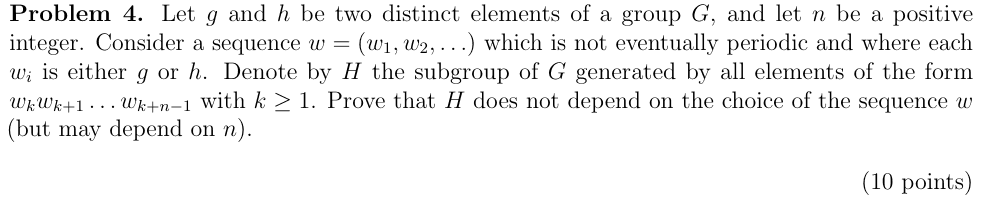
Let and be two distinct elements of a group , and let be a positive integer. Consider a sequence which is not eventually periodic and where each is either or . Denote by the subgroup of generated by all elements of the form with . Prove that does not depend on the choice of the sequence (but may depend on ).
Original from the official PDF
This transcription was compared symbol by symbol with the original, but not yet by a person.
Work for at least 45 minutes before opening the solution.
Official solution
(proposed by Ivan Mitrofanov, Saarland University)
Solution. Let denote the subset of of products of the form , where each is either or .
Lemma. For all and for all the ratio is contained in .
Proof. Induction in .
We start with the base case . By the pigeonhole principle, there exist for which the sequences and coincide. If for all positive integer , then the sequence is eventually periodic with period . Thus, there exists for which . We have , so for . Therefore, since the products and both are elements of , the subgroup contains their ratios and . These ratios are equal to and (in some order), that finishes the proof for .
Induction step from to , . We say that an element is a -element, correspondingly an -element, if it can be represented as , correspondingly , where . The ratio of two -elements, or of two -elements, is a ratio of two elements of , thus, it is in by the induction hypothesis. Since the property is an equivalence relation on pairs , it suffices to find a -element and -element whose ratio is in .
Define , as in the base case. The subgroup contains the products
Their ratio is a ratio of -element and an -element in , since and for all .
The Lemma for yields that is the subgroup of generated by , and this description does not depend on .
Transcribed from the official solutions, pages 4–5. This transcription has not been checked a second time; if in doubt, look at the original.
Archive problem: the statement is the official text (transcribed, with the original above). Subject classification and difficulty were estimated automatically; hints and a worked solution are added over time.
How did it go?
Moves you mark come back sooner in triage.