IMC 2025, Day 2, Problem 10
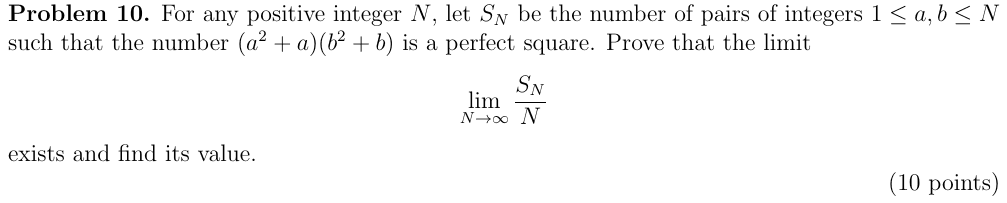
For any positive integer , let be the number of pairs of integers such that the number is a perfect square. Prove that the limit
exists and find its value.
Original from the official PDF
This transcription was compared symbol by symbol with the original, but not yet by a person.
Work for at least 45 minutes before opening the solution.
Official solution
(proposed by Besfort Shala, University of Bristol)
Solution. Throughout the solution, we use the Vinogradov notation to mean , which in turn means that there exists a constant , independent of the quantities and , such that , on the entirety of the domain where and are defined (for us, this will always be the interval .)
We will show that the limit equals , corresponding to the trivial solutions . Note that is a perfect square if and only if and for some square-free and . From this point on, all sums over will be over square-free positive integers. Multiplying the equations by and setting , we get
Note that if , then the size of the second solution (coming from , where is the fundamental solution) is . Hence we may assume that if (with a suitable choice of hidden constants). Denote the second sum by (for error, which we will bound momentarily). The first sum is easily manipulated into being asymptotic to (up to the error ), using the fact that fixing fixes the square-free and the square , namely
Now we bound the error sum . Note that solutions to Pell’s equation grow exponentially, hence we have . This means we may assume that for some small enough fixed , since the contribution of is bounded by . By , we have that implies .
Fixing each gives choices for (hence also for ). So we may assume , since the contribution of is bounded by .
By placing in residue classes modulo and splitting the interval into intervals of length , we get that each choice of gives choices for (hence also for ) by , where . By elementary number theory, is multiplicative and for all prime powers . In particular we obtain for any (this is not hard to prove directly for , but may be used as a well-known fact for the divisor function ). Therefore the contribution of such is
Remark. There is a secondary infinite family of solutions of “size” , namely given by . This shows that
Transcribed from the official solutions, pages 6–7. This transcription has not been checked a second time; if in doubt, look at the original.
Archive problem: the statement is the official text (transcribed, with the original above). Subject classification and difficulty were estimated automatically; hints and a worked solution are added over time.
How did it go?
Moves you mark come back sooner in triage.