IMC 2026
All the problems of the year on one page, as on the contest paper.
Official files
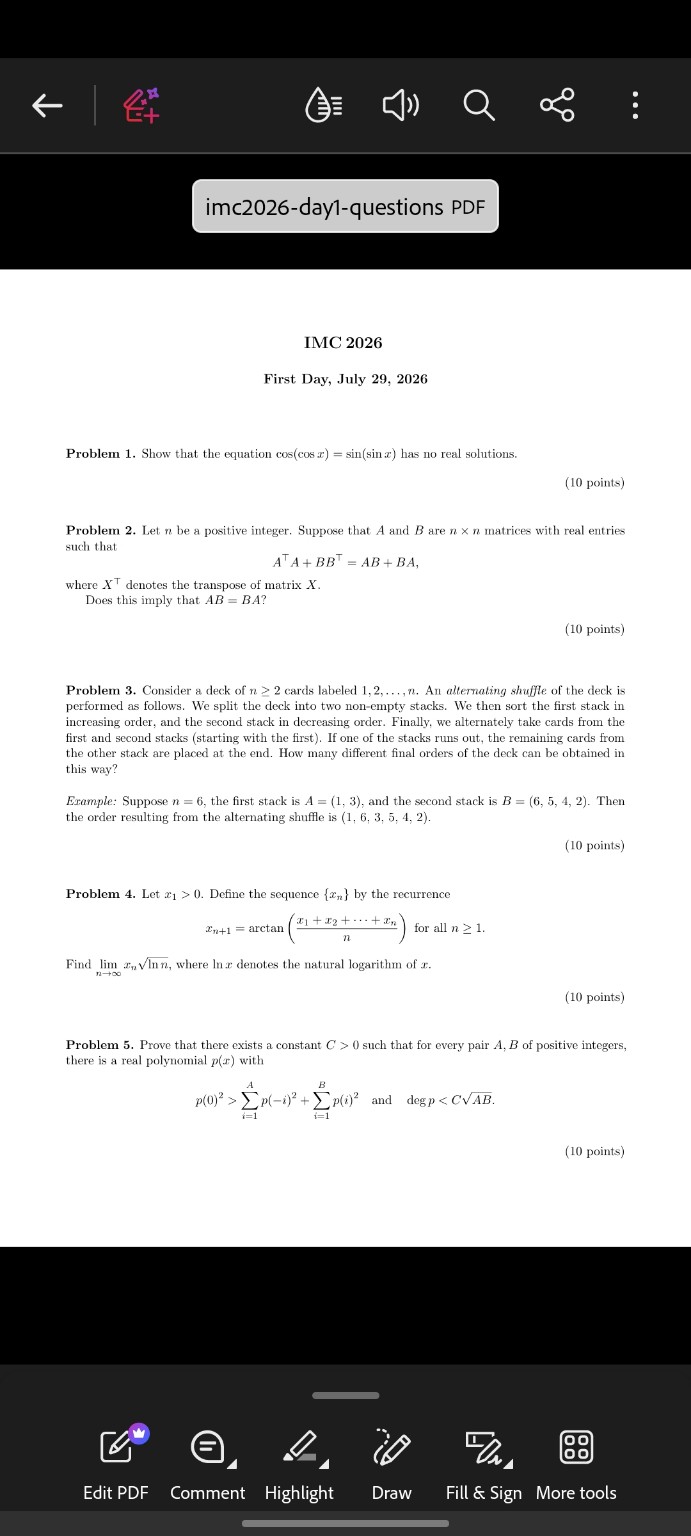
- Day 1: photo of the problem sheet (image)
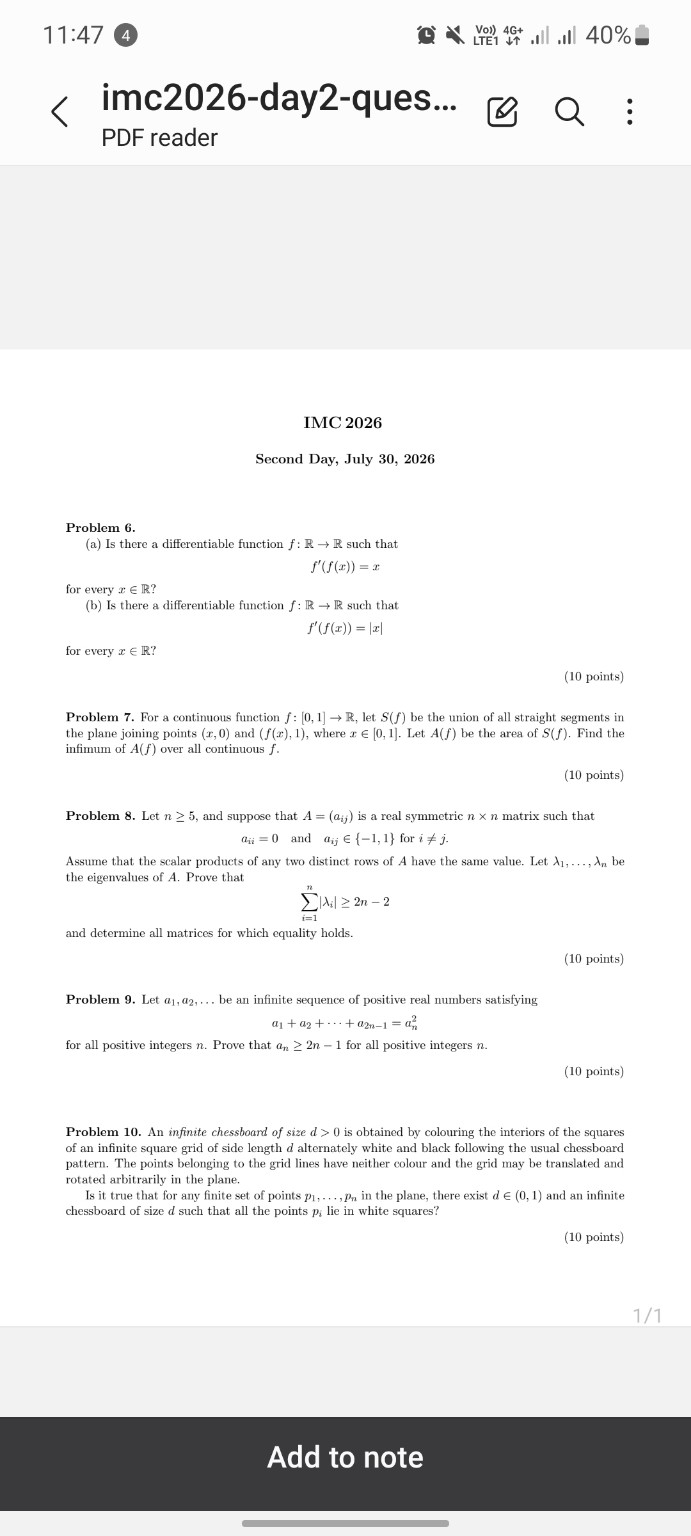
- Day 2: photo of the problem sheet (image)
- Day 1: problems (official site)
- Day 1: solutions (PDF)
- Day 1: marking schemes (official site)
- Day 2: problems (official site)
- Day 2: solutions (PDF)
- Day 2: marking schemes (official site)
Problem 1 (Day 1)
Show that the equation has no real solutions.
Problem 2 (Day 1)
Let be a positive integer. Suppose that and are matrices with real entries such that
where denotes the transpose of matrix .
Does this imply that ?
Problem 3 (Day 1)
Consider a deck of cards labeled . An alternating shuffle of the deck is performed as follows. We split the deck into two non-empty stacks. We then sort the first stack in increasing order, and the second stack in decreasing order. Finally, we alternately take cards from the first and second stacks (starting with the first). If one of the stacks runs out, the remaining cards from the other stack are placed at the end. How many different final orders of the deck can be obtained in this way?
Example: Suppose , the first stack is , and the second stack is . Then the order resulting from the alternating shuffle is .
Problem 4 (Day 1)
Let . Define the sequence by the recurrence
Find , where denotes the natural logarithm of .
Problem 5 (Day 1)
Prove that there exists a constant such that for every pair of positive integers, there is a real polynomial with
Problem 6 (Day 2)
(a) Is there a differentiable function such that
for every ?
(b) Is there a differentiable function such that
for every ?
Problem 7 (Day 2)
For a continuous function , let be the union of all straight segments in the plane joining points and , where . Let be the area of . Find the infimum of over all continuous .
Problem 8 (Day 2)
Let , and suppose that is a real symmetric matrix such that
Assume that the scalar products of any two distinct rows of have the same value. Let be the eigenvalues of . Prove that
and determine all matrices for which equality holds.
Problem 9 (Day 2)
Let be an infinite sequence of positive real numbers satisfying
for all positive integers . Prove that for all positive integers .
Problem 10 (Day 2)
An infinite chessboard of size is obtained by colouring the interiors of the squares of an infinite square grid of side length alternately white and black following the usual chessboard pattern. The points belonging to the grid lines have neither colour and the grid may be translated and rotated arbitrarily in the plane.
Is it true that for any finite set of points in the plane, there exist and an infinite chessboard of size such that all the points lie in white squares?