uniolympiads Ελληνικά

IMC 2026, Day 1, Problem 5

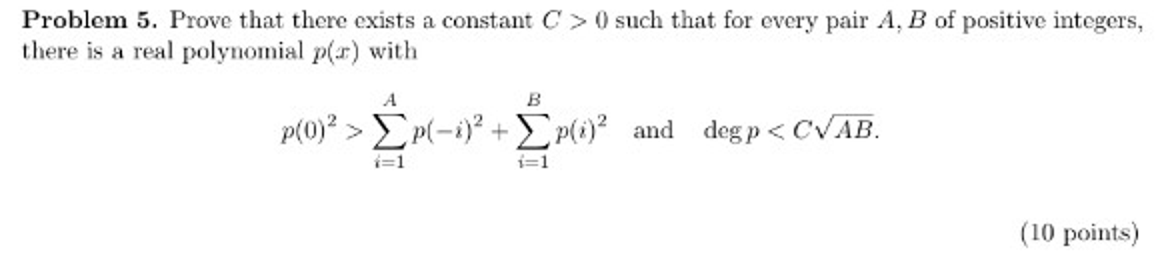
Prove that there exists a constant C>0C > 0 such that for every pair A,BA, B of positive integers, there is a real polynomial p(x)p(x) with

p(0)2>∑i=1Ap(−i)2+∑i=1Bp(i)2anddeg⁡p<CAB.p(0)^2 > \sum_{i=1}^{A} p(-i)^2 + \sum_{i=1}^{B} p(i)^2 \quad \text{and} \quad \deg p < C\sqrt{AB}.
Original from the official PDFProve that there exists a constant C > 0 such that for every pair A, B of positive integers, there is a real polynomial p(x) with p(0)² > ∑ p(−i)² + ∑ p(i)² and deg p < C √AB.

This transcription was compared symbol by symbol with the original, but not yet by a person.

Time on this problem 0:00

Work for at least 45 minutes before opening the solution.

Official solution

(proposed by Géza Kós, Loránd Eötvös University, Budapest)

Solution. Without loss of generality we can assume A≥BA \ge B.

Let kk be an odd integer with 7AB≤k≤7AB+27\sqrt{AB} \le k \le 7\sqrt{AB} + 2, and consider the Chebishev polynomial Tk(x)T_k(x). Let ω=arccos⁡A−BA+B\omega = \arccos\dfrac{A-B}{A+B}, and let u0=cos⁡ω0u_0 = \cos\omega_0 be the greatest root of Tk(x)T_k(x) in the interval [−1,A−BA+B]\left[-1, \dfrac{A-B}{A+B}\right]. Since kk is odd, we have Tk(0)=0T_k(0) = 0, so u0≥0u_0 \ge 0. Moreover, ω≤ω0<ω+πk\omega \le \omega_0 < \omega + \dfrac{\pi}{k}.

The requested polynomial will be constructed as

p(x)=Tk(u0+1+u0Ax)x.p(x) = \frac{T_k\left(u_0 + \dfrac{1+u_0}{A}x\right)}{x}.
Notice that for all x∈[−A,B]x \in [-A, B] we have
u0+1+u0Ax≥u0+1+u0A(−A)=−1andu0+1+u0Ax≤A−BA+B+1+A−BA+BAB=1.u_0 + \frac{1+u_0}{A}x \ge u_0 + \frac{1+u_0}{A}(-A) = -1 \quad \text{and} \quad u_0 + \frac{1+u_0}{A}x \le \frac{A-B}{A+B} + \frac{1 + \frac{A-B}{A+B}}{A}B = 1.
Hence, for x∈[−A,B]x \in [-A, B] we have ∣Tk(u0+1+u0Ax)∣≤1\left|T_k\left(u_0 + \dfrac{1+u_0}{A}x\right)\right| \le 1 and ∣p(x)∣≤1∣x∣|p(x)| \le \dfrac{1}{|x|}, and therefore
∑i=1A∣p(−i)∣2+∑i=1B∣p(i)∣2<2∑i=1∞1i2=π23<4.\sum_{i=1}^{A} |p(-i)|^2 + \sum_{i=1}^{B} |p(i)|^2 < 2\sum_{i=1}^{\infty} \frac{1}{i^2} = \frac{\pi^2}{3} < 4.

In order to estimate p(0)p(0), notice that

∣p(0)∣=1+u0A∣Tk′(u0)∣≥1A∣Tk′(u0)∣.|p(0)| = \frac{1+u_0}{A}|T_k'(u_0)| \ge \frac{1}{A}|T_k'(u_0)|.
From cos⁡(kt)=Tk(cos⁡t)\cos(kt) = T_k(\cos t) we get
−ksin⁡(kt)=Tk′(cos⁡t)⋅(−sin⁡t)-k\sin(kt) = T_k'(\cos t)\cdot(-\sin t)
T′(u0)=T′(cos⁡ω0)=ksin⁡(kω0)sin⁡ω0=±ksin⁡ω0.T'(u_0) = T'(\cos\omega_0) = k\frac{\sin(k\omega_0)}{\sin\omega_0} = \pm\frac{k}{\sin\omega_0}.
Since ω0≤min⁡(ω+πk,π2)\omega_0 \le \min\left(\omega + \frac{\pi}{k}, \frac{\pi}{2}\right),
sin⁡ω0<sin⁡ω+πk≤1−cos⁡2ω+π7AB=1−(A−BA+B)2+π/7AB=2ABA+B+π/7AB<3BA.\begin{aligned} \sin\omega_0 &< \sin\omega + \frac{\pi}{k} \le \sqrt{1 - \cos^2\omega} + \frac{\pi}{7\sqrt{AB}} \\ &= \sqrt{1 - \left(\frac{A-B}{A+B}\right)^2} + \frac{\pi/7}{\sqrt{AB}} = \frac{2\sqrt{AB}}{A+B} + \frac{\pi/7}{\sqrt{AB}} < 3\sqrt{\frac{B}{A}}. \end{aligned}
Hence,
∣p(0)∣≥1A∣Tk′(u0)∣=1A⋅ksin⁡ω0>7ABA⋅3BA>2,|p(0)| \ge \frac{1}{A}|T_k'(u_0)| = \frac{1}{A}\cdot\frac{k}{\sin\omega_0} > \frac{7\sqrt{AB}}{A\cdot 3\sqrt{\frac{B}{A}}} > 2,
so indeed
∣p(0)∣2>4>∑i=1A∣p(−i)∣2+∑i=1B∣p(i)∣2.|p(0)|^2 > 4 > \sum_{i=1}^{A} |p(-i)|^2 + \sum_{i=1}^{B} |p(i)|^2.

The degree of pp is

deg⁡p=k−1<7AB+1≤8AB.\deg p = k - 1 < 7\sqrt{AB} + 1 \le 8\sqrt{AB}.
So, C=8C = 8 is suitable.

Transcribed from the official solutions, page 7. This transcription has not been checked a second time; if in doubt, look at the original.

Archive problem: the statement is the official text (transcribed, with the original above). Subject classification and difficulty were estimated automatically; hints and a worked solution are added over time.
How did it go?