uniolympiads Ελληνικά

SEEMOUS 2020, Problem 4

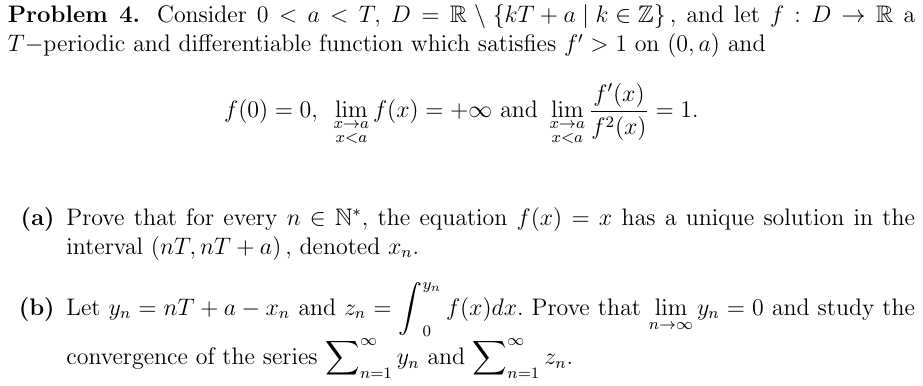
Consider 0<a<T0 < a < T, D=R∖{kT+a∣k∈Z}D = \mathbb{R} \setminus \{kT + a \mid k \in \mathbb{Z}\}, and let f ⁣:D→Rf\colon D \to \mathbb{R} a TT-periodic and differentiable function which satisfies f′>1f' > 1 on (0,a)(0, a) and

f(0)=0,lim⁡x→ax<af(x)=+∞  and lim⁡x→ax<af′(x)f2(x)=1.f(0) = 0, \quad \lim_{\substack{x\to a \\ x<a}} f(x) = +\infty \ \text{ and } \lim_{\substack{x\to a \\ x<a}} \frac{f'(x)}{f^2(x)} = 1.

(a) Prove that for every n∈N∗n \in \mathbb{N}^*, the equation f(x)=xf(x) = x has a unique solution in the interval (nT,nT+a)(nT, nT + a), denoted xnx_n.

(b) Let yn=nT+a−xny_n = nT + a - x_n and zn=∫0ynf(x) dxz_n = \int_0^{y_n} f(x)\,dx. Prove that lim⁡n→∞yn=0\lim_{n\to\infty} y_n = 0 and study the convergence of the series ∑n=1∞yn\sum_{n=1}^{\infty} y_n and ∑n=1∞zn\sum_{n=1}^{\infty} z_n.

Original from the official PDFConsider 0 < a < T, D = R \ {kT + a | k ∈ Z} , and let f : D → R a T −periodic and differentiable function which satisfies f 0 > 1 on (0, a) and f 0 (x) = 1. f 2 (x) x<a f (0) = 0, x→a lim f (x) = +∞ and x→a lim x<a (a) Prove that for every n ∈ N ∗ , the equation f (x) = x has a unique solution in the interval (nT, nT + a) , denoted x n . Z y n (b) Let y n = nT + a − x n and z n = f (x)dx. Prove that lim y n = 0 and study the n→∞ 0 X ∞ X ∞ convergence of the series y n and z n . n=1 n=1

This transcription was compared symbol by symbol with the original, but not yet by a person.

Time on this problem 0:00

Work for at least 45 minutes before opening the solution.

Official solution

Proof. (1) Observe first that, for every n∈N∗n\in\mathbb{N}^*, f(nT)=0f(nT) = 0 and lim⁡x→nT+ax<nT+af(x)=+∞\lim\limits_{\substack{x\to nT+a\\ x<nT+a}} f(x) = +\infty, hence the equation f(x)=xf(x) = x has at least one solution in the interval (nT,nT+a)(nT, nT+a).

Now, consider the function g(x)=f(x)−xg(x) = f(x) - x on (nT,nT+a)(nT, nT+a) and observe that if there would exist two solutions of the equation f(x)=xf(x) = x, say xn1<xn2x_n^1 < x_n^2, by Rolle's Theorem, there exists rn∈(xn1,xn2)⊂(nT,nT+a)r_n\in(x_n^1, x_n^2)\subset(nT, nT+a) such that g′(rn)=f′(rn)−1=0g'(r_n) = f'(r_n) - 1 = 0, a contradiction, since f′>1f' > 1 on (nT,nT+a)(nT, nT+a) by periodicity.

(2) Observe that for any nn, ff is strictly increasing on (nT,nT+a)(nT, nT+a). We prove that (yn)(y_n) is decreasing. By contradiction, suppose that yn<yn+1y_n < y_{n+1} for some nn. Then T+xn>xn+1T + x_n > x_{n+1}, and by the monotonicity of ff that

xn=f(xn)=f(xn+T)>f(xn+1)=xn+1,x_n = f(x_n) = f(x_n+T) > f(x_{n+1}) = x_{n+1},
an obvious contradiction.

Since yn∈(0,a)y_n\in(0,a) for every nn, it follows that (yn)(y_n) it converges. Then there exists y‾≥0\overline{y}\ge 0 such that yn→y‾y_n\to\overline{y}. Suppose, by contradiction, that y‾>0\overline{y} > 0. Observe that y‾<a\overline{y} < a. Since xn−nT→a−y‾x_n - nT\to a - \overline{y} for n→∞n\to\infty, it follows by the continuity of ff on (−T,a)(-T, a) that f(xn−nT)→f(a−y‾)∈Rf(x_n - nT)\to f(a-\overline{y})\in\mathbb{R} for n→∞n\to\infty. But f(xn−nT)=f(xn)=xn→∞f(x_n - nT) = f(x_n) = x_n\to\infty, hence we obtain a contradiction. Therefore, yn→0y_n\to 0.

Next, we will prove that

lim⁡n→∞n⋅yn=1T,\lim_{n\to\infty} n\cdot y_n = \frac{1}{T},
hence ∑n=1∞yn\sum_{n=1}^{\infty} y_n diverges by a comparison test.

For that, observe that

lim⁡n→∞n⋅yn=lim⁡n→∞nTTxn⋅xnyn=1Tlim⁡n→∞xnyn.\lim_{n\to\infty} n\cdot y_n = \lim_{n\to\infty}\frac{nT}{Tx_n}\cdot x_n y_n = \frac{1}{T}\lim_{n\to\infty} x_n y_n.
Moreover,
lim⁡n→∞xnyn=lim⁡n→∞f(xn)⋅yn=lim⁡n→∞f(nT+a−yn)⋅yn=lim⁡n→∞yn1f(a−yn)=−lim⁡n→∞(a−yn)−a1f(a−yn).\begin{aligned} \lim_{n\to\infty} x_n y_n &= \lim_{n\to\infty} f(x_n)\cdot y_n = \lim_{n\to\infty} f(nT + a - y_n)\cdot y_n \\ &= \lim_{n\to\infty}\frac{y_n}{\frac{1}{f(a-y_n)}} = -\lim_{n\to\infty}\frac{(a-y_n) - a}{\frac{1}{f(a-y_n)}}. \end{aligned}
But a−yna - y_n converges increasingly to aa so the previous limit is
−lim⁡x→ax<ax−a1f(x)=−lim⁡x→ax<a1−f′(x)f2(x)=1.-\lim_{\substack{x\to a\\ x<a}}\frac{x-a}{\frac{1}{f(x)}} = -\lim_{\substack{x\to a\\ x<a}}\frac{1}{-\frac{f'(x)}{f^2(x)}} = 1.
For the second series, observe that for every nn, there is cn∈(0,yn)c_n\in(0, y_n) such that zn=yn⋅f(cn)z_n = y_n\cdot f(c_n). Since ff is increasing on (0,a)(0,a),
zn≤yn⋅f(yn)=yn2⋅f(yn)yn.z_n \le y_n\cdot f(y_n) = y_n^2\cdot\frac{f(y_n)}{y_n}.
But ff is differentiable at 00, and f(yn)yn→f′(0)≥0\dfrac{f(y_n)}{y_n}\to f'(0)\ge 0 for n→∞n\to\infty, hence there exists M>0M > 0 such that, for any large nn,
f(yn)yn≤M.\frac{f(y_n)}{y_n}\le M.
Then there exist n0∈Nn_0\in\mathbb{N} and K>0K > 0 such that
0≤zn≤Kn2,∀n≥n0.0\le z_n\le\frac{K}{n^2}, \quad \forall n\ge n_0.
By a comparison test, ∑n=1∞zn\sum_{n=1}^{\infty} z_n converges.

Transcribed from the official solutions, pages 4–5. This transcription has not been checked a second time; if in doubt, look at the original.
Archive problem: the statement is the official text (transcribed, with the original above). Subject classification and difficulty were estimated automatically; hints and a worked solution are added over time.

How did it go?