uniolympiads English

IMC 1996, Ημέρα 1, Θέμα 1

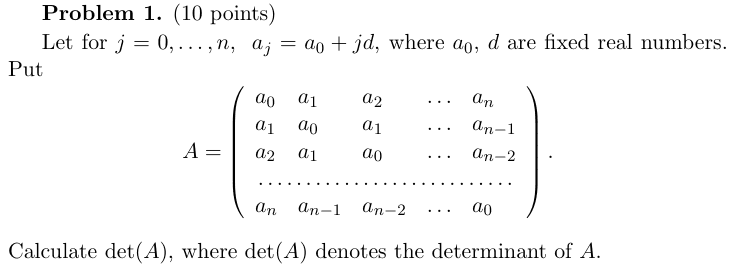
Let for j=0,…,nj = 0, \dots, n, aj=a0+jda_j = a_0 + jd, where a0a_0, dd are fixed real numbers. Put

A=(a0a1a2…ana1a0a1…an−1a2a1a0…an−2⋯⋯⋯⋯⋯anan−1an−2…a0).A = \begin{pmatrix} a_0 & a_1 & a_2 & \dots & a_n \\ a_1 & a_0 & a_1 & \dots & a_{n-1} \\ a_2 & a_1 & a_0 & \dots & a_{n-2} \\ \cdots & \cdots & \cdots & \cdots & \cdots \\ a_n & a_{n-1} & a_{n-2} & \dots & a_0 \end{pmatrix}.

Calculate det⁡(A)\det(A), where det⁡(A)\det(A) denotes the determinant of AA.

Πρωτότυπο από το επίσημο PDFLet for j = 0, . . . , n, a j = a 0 + jd, where a 0 , d are fixed real numbers. Put   a 0 a 1 a 2 . . . a n  a a 1 . . . a n−1    1 a 0   a 0 . . . a n−2  . A =  a 2 a 1    ...........................  a n a n−1 a n−2 . . . a 0 Calculate det(A), where det(A) denotes the determinant of A.

Η μεταγραφή συγκρίθηκε σύμβολο προς σύμβολο με το πρωτότυπο, όχι ακόμα από άνθρωπο.

Χρόνος σε αυτό το θέμα 0:00

Δούλεψε τουλάχιστον 45 λεπτά πριν ανοίξεις τη λύση.

Επίσημη λύση

Solution. Adding the first column of AA to the last column we get that

det⁡(A)=(a0+an)det⁡(a0a1a2…1a1a0a1…1a2a1a0…1⋯⋯⋯⋯⋯anan−1an−2…1).\det(A) = (a_0 + a_n) \det \begin{pmatrix} a_0 & a_1 & a_2 & \dots & 1 \\ a_1 & a_0 & a_1 & \dots & 1 \\ a_2 & a_1 & a_0 & \dots & 1 \\ \cdots & \cdots & \cdots & \cdots & \cdots \\ a_n & a_{n-1} & a_{n-2} & \dots & 1 \end{pmatrix}.

Subtracting the nn-th row of the above matrix from the (n+1)(n+1)-st one, (n−1)(n-1)-st from nn-th, …\dots, first from second we obtain that

det⁡(A)=(a0+an)det⁡(a0a1a2…1d−d−d…0dd−d…0⋯⋯⋯⋯⋯ddd…0).\det(A) = (a_0 + a_n) \det \begin{pmatrix} a_0 & a_1 & a_2 & \dots & 1 \\ d & -d & -d & \dots & 0 \\ d & d & -d & \dots & 0 \\ \cdots & \cdots & \cdots & \cdots & \cdots \\ d & d & d & \dots & 0 \end{pmatrix}.

Hence,

det⁡(A)=(−1)n(a0+an)det⁡(d−d−d…−ddd−d…−dddd…−d⋯⋯⋯⋯⋯ddd…d).\det(A) = (-1)^n (a_0 + a_n) \det \begin{pmatrix} d & -d & -d & \dots & -d \\ d & d & -d & \dots & -d \\ d & d & d & \dots & -d \\ \cdots & \cdots & \cdots & \cdots & \cdots \\ d & d & d & \dots & d \end{pmatrix}.

Adding the last row of the above matrix to the other rows we have

det⁡(A)=(−1)n(a0+an)det⁡(2d00…02d2d0…02d2d2d…0⋯⋯⋯⋯⋯ddd…d)=(−1)n(a0+an)2n−1dn.\det(A) = (-1)^n (a_0+a_n) \det \begin{pmatrix} 2d & 0 & 0 & \dots & 0 \\ 2d & 2d & 0 & \dots & 0 \\ 2d & 2d & 2d & \dots & 0 \\ \cdots & \cdots & \cdots & \cdots & \cdots \\ d & d & d & \dots & d \end{pmatrix} = (-1)^n (a_0+a_n) 2^{n-1} d^n.

Μεταγραφή από το επίσημο κείμενο λύσεων, σελίδες 2–3. Η μεταγραφή δεν έχει ελεγχθεί δεύτερη φορά· αν έχεις αμφιβολία, κοίτα το πρωτότυπο.

Θέμα αρχείου: η εκφώνηση είναι το επίσημο κείμενο (μεταγραμμένο, με το πρωτότυπο παραπάνω). Η ταξινόμηση ανά αντικείμενο και η δυσκολία εκτιμήθηκαν αυτόματα· υποδείξεις και λύση στα ελληνικά προστίθενται σταδιακά.

Πώς πήγε;