uniolympiads English

IMC 1996, Ημέρα 1, Θέμα 2

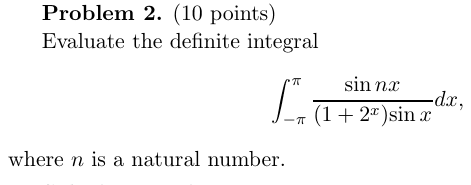
Evaluate the definite integral

∫−ππsin⁡nx(1+2x)sin⁡x dx,\int_{-\pi}^{\pi} \frac{\sin nx}{(1 + 2^x)\sin x}\,dx,

where nn is a natural number.

Πρωτότυπο από το επίσημο PDFEvaluate the definite integral Z π sin nx dx, x −π (1 + 2 )sin x where n is a natural number.

Η μεταγραφή συγκρίθηκε σύμβολο προς σύμβολο με το πρωτότυπο, όχι ακόμα από άνθρωπο.

Χρόνος σε αυτό το θέμα 0:00

Δούλεψε τουλάχιστον 45 λεπτά πριν ανοίξεις τη λύση.

Επίσημη λύση

Solution. We have

In=∫−ππsin⁡nx(1+2x)sin⁡xdx=∫0πsin⁡nx(1+2x)sin⁡xdx+∫−π0sin⁡nx(1+2x)sin⁡xdx.\begin{aligned} I_n &= \int_{-\pi}^{\pi} \frac{\sin nx}{(1+2^x)\sin x} dx \\ &= \int_0^{\pi} \frac{\sin nx}{(1+2^x)\sin x} dx + \int_{-\pi}^{0} \frac{\sin nx}{(1+2^x)\sin x} dx. \end{aligned}

In the second integral we make the change of variable x=−xx = -x and obtain

In=∫0πsin⁡nx(1+2x)sin⁡xdx+∫0πsin⁡nx(1+2−x)sin⁡xdx=∫0π(1+2x)sin⁡nx(1+2x)sin⁡xdx=∫0πsin⁡nxsin⁡xdx.\begin{aligned} I_n &= \int_0^{\pi} \frac{\sin nx}{(1+2^x)\sin x} dx + \int_0^{\pi} \frac{\sin nx}{(1+2^{-x})\sin x} dx \\ &= \int_0^{\pi} \frac{(1+2^x)\sin nx}{(1+2^x)\sin x} dx \\ &= \int_0^{\pi} \frac{\sin nx}{\sin x} dx. \end{aligned}

For n≥2n \geq 2 we have

In−In−2=∫0πsin⁡nx−sin⁡ (n−2)xsin⁡xdx=2∫0πcos⁡ (n−1)xdx=0.\begin{aligned} I_n - I_{n-2} &= \int_0^{\pi} \frac{\sin nx - \sin\,(n-2)x}{\sin x} dx \\ &= 2 \int_0^{\pi} \cos\,(n-1)x dx = 0. \end{aligned}

The answer

In={0if n is even,πif n is oddI_n = \begin{cases} 0 & \text{if } n \text{ is even,} \\ \pi & \text{if } n \text{ is odd} \end{cases}

follows from the above formula and I0=0I_0 = 0, I1=πI_1 = \pi.

Μεταγραφή από το επίσημο κείμενο λύσεων, σελίδες 3–4. Η μεταγραφή δεν έχει ελεγχθεί δεύτερη φορά· αν έχεις αμφιβολία, κοίτα το πρωτότυπο.

Θέμα αρχείου: η εκφώνηση είναι το επίσημο κείμενο (μεταγραμμένο, με το πρωτότυπο παραπάνω). Η ταξινόμηση ανά αντικείμενο και η δυσκολία εκτιμήθηκαν αυτόματα· υποδείξεις και λύση στα ελληνικά προστίθενται σταδιακά.

Πώς πήγε;